Skip to content
  • Biodiversity
    • Why is Biodiversity Important?
    • Threats to Biodiversity
    • What are Species at Risk?
    • Recovery Planning
    • Environmental Monitoring
  • Species at Risk
    • Species at Risk
      • SAR in the Sydenham
      • Mussels
      • Fishes
      • Snakes
      • Turtles
    • Mussels
      • Eastern Pondmussel
      • Fawnsfoot
      • Kidneyshell
      • Lilliput
      • Mapleleaf
      • Northern Riffleshell
      • Purple Wartyback
      • Rainbow
      • Rayed Bean
      • Round Hickorynut
      • Round Pigtoe
      • Salamander Mussel
      • Snuffbox
      • Threehorn Wartyback
      • Wavy-rayed Lampmussel
    • Fishes
      • Blackstripe Topminnow
      • Eastern Sand Darter
      • Grass Pickerel
      • Northern Madtom
      • Northern Sunfish
      • Pugnose Minnow
      • Pugnose Shiner
      • River Darter
      • Silver Lamprey
      • Spotted Sucker
    • Snakes
      • Eastern Foxsnake
      • Eastern Hog-nosed Snake
      • Eastern Milksnake
    • Turtles
      • Blanding’s Turtle
      • Midland Painted Turtle
      • Northern Map Turtle
      • Snapping Turtle
      • Spiny Softshell
  • Stewardship
    • Healthy Watersheds Program
      • Sydenham Phosphorus Reduction Initiative
    • Managing Phosphorus
    • Phosphorus StoryMap
    • Reducing Pollution in Runoff
    • Best Management Practices Resources
  • Stories
  • Get Involved
    • What Can I Do?
    • Take the Stewardship Survey
    • Test Your ID Skills!
    • Report a Turtle Sighting
  • Resources
  • Contact Us
Sydenham River WatershedSydenham River Watershed
  • Biodiversity
    • Why is Biodiversity Important?
    • Threats to Biodiversity
    • What are Species at Risk?
    • Recovery Planning
    • Environmental Monitoring
  • Species at Risk
    • Species at Risk
      • SAR in the Sydenham
      • Mussels
      • Fishes
      • Snakes
      • Turtles
    • Mussels
      • Eastern Pondmussel
      • Fawnsfoot
      • Kidneyshell
      • Lilliput
      • Mapleleaf
      • Northern Riffleshell
      • Purple Wartyback
      • Rainbow
      • Rayed Bean
      • Round Hickorynut
      • Round Pigtoe
      • Salamander Mussel
      • Snuffbox
      • Threehorn Wartyback
      • Wavy-rayed Lampmussel
    • Fishes
      • Blackstripe Topminnow
      • Eastern Sand Darter
      • Grass Pickerel
      • Northern Madtom
      • Northern Sunfish
      • Pugnose Minnow
      • Pugnose Shiner
      • River Darter
      • Silver Lamprey
      • Spotted Sucker
    • Snakes
      • Eastern Foxsnake
      • Eastern Hog-nosed Snake
      • Eastern Milksnake
    • Turtles
      • Blanding’s Turtle
      • Midland Painted Turtle
      • Northern Map Turtle
      • Snapping Turtle
      • Spiny Softshell
  • Stewardship
    • Healthy Watersheds Program
      • Sydenham Phosphorus Reduction Initiative
    • Managing Phosphorus
    • Phosphorus StoryMap
    • Reducing Pollution in Runoff
    • Best Management Practices Resources
  • Stories
  • Get Involved
    • What Can I Do?
    • Take the Stewardship Survey
    • Test Your ID Skills!
    • Report a Turtle Sighting
  • Resources
  • Contact Us

Northern Map Turtle

Home Species at Risk in the SydenhamTurtlesNorthern Map Turtle

Northern Map Turtle

Graptemys geographica

COSEWIC: Special Concern
SARA: Special Concern
COSSARO: Special Concern
SARO: Special Concern

Species Description

If you were to gaze upon the shell of a Northern Map Turtle, you may be forgiven for thinking you were staring at a map and wondering where it leads. The unique yellow pattern on the carapace (upper shell) resembles the contour lines found on a topographic map, hence their name. Map Turtles are medium-sized, with the carapace of adult males reaching up to 16cm in length and adult females reaching up to 27cm. They are sexually dimorphic, meaning males and females look different – females can be more than twice the size of males.

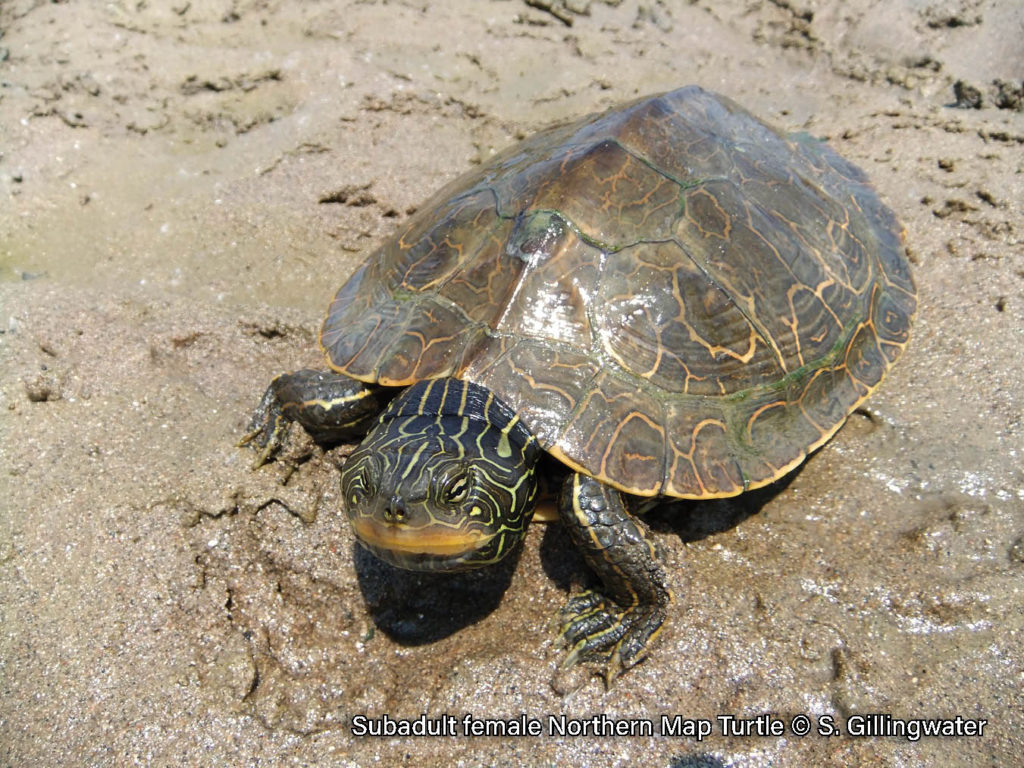
The carapace (upper shell) of Map Turtles ranges in colour from brown to olive and can be distinguished from Ontario’s other turtles by the presence of a ridge down the midline of its shell, known as a keel, along with a serrated rear margin. The plastron (lower shell) is yellow to cream and the skin of the neck, head and limbs are dark olive to brown-black and covered with yellow stripes. Map Turtles also have a characteristic yellow spot behind each eye.

Picture of an adult female Northern Map Turtle in shallow water. The turtle has a brown shell with a yellow contour line pattern, a ridge down the midline of its shell, and the back edge is serrated. It has yellow lines on its neck and a yellow spot behind its eye.
Picture of an adult male Northern Map Turtle. The turtle has a brown shell with a yellow contour line pattern, a ridge down the midline of its shell, and the back edge is serrated. It has yellow lines on its neck and a yellow spot behind its eye.

Diet

A specialized carnivore, Northern Map Turtles feed primarily on molluscs such as mussels and snails but their diet also includes crayfish and aquatic insect larvae. Map Turtles, particularly the females, have a broad head and strong jaw that make quick work of the protective shells much of their prey use as a defence.

The diet of females consists more of molluscs whereas the smaller males have a diet that is more similar to juveniles who consume more aquatic insects.

Close-up picture of an adult Northern Map Turtle's head. It has yellow lines on its neck and a yellow spot behind its eye.

Habitat

Northern Map Turtles can be found in rivers and marshy or nearshore areas of lakes, they have a preference for waters that are shallow, have moderate flows, a soft-bottom, and good basking habitat such as logs, rock, and exposed banks. They lead a highly aquatic lifestyle and require areas with good water quality and are intolerant of waters with low oxygen levels. Terrestrial habitat is rarely used except during the nesting season and for basking. Described as a social species, Map Turtles will gather and jostle at prime basking sites to absorb the sun’s warmth. To survive the harsh Ontario winters, Map Turtles overwinter for 5 to 6 months at the soft-bottom of oxygen-rich lakes and rivers, 0.5-11m below the surface, hiding under exposed ledges, boulders, and tree trunks.

Distribution

The Northern Map Turtle is found in eastern North America with approximately 10% of its global range in Canada occurring in central and southern Ontario and southwestern Quebec in the Great Lakes-St. Lawrence basin.

In southwestern Ontario, Map Turtles live in areas of Lake St. Clair, Lake Erie, and Lake Ontario with undeveloped shoreline as well as major tributaries in the region including the Sydenham, Ausable, Thames, Detroit, and Grand rivers.

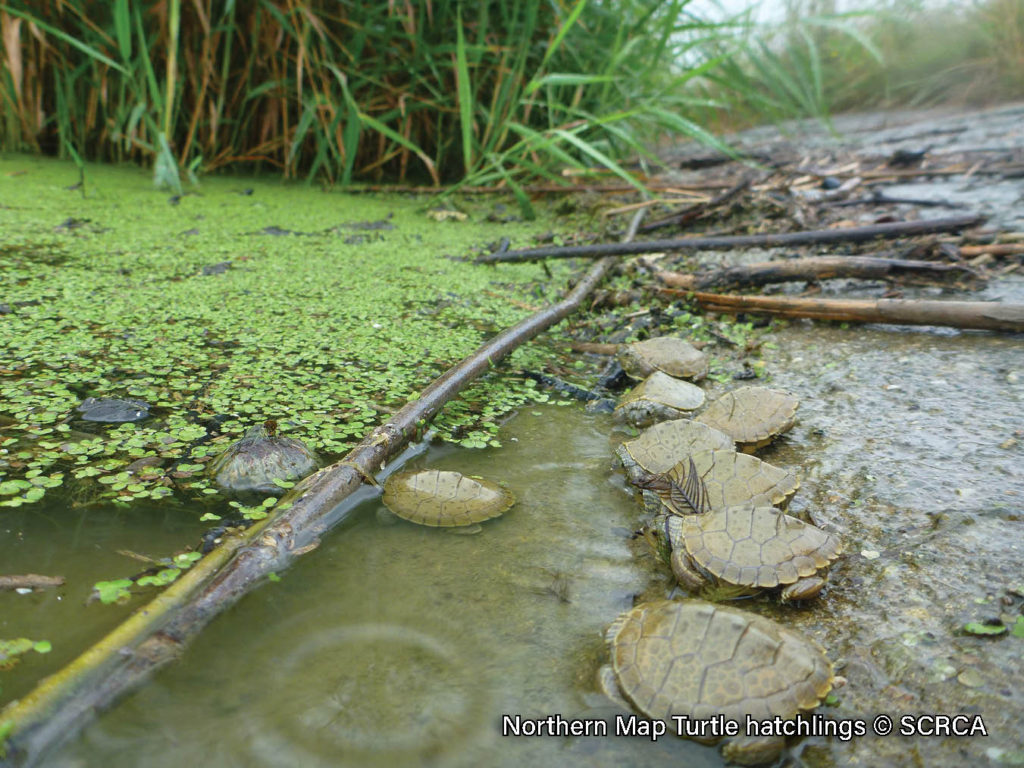
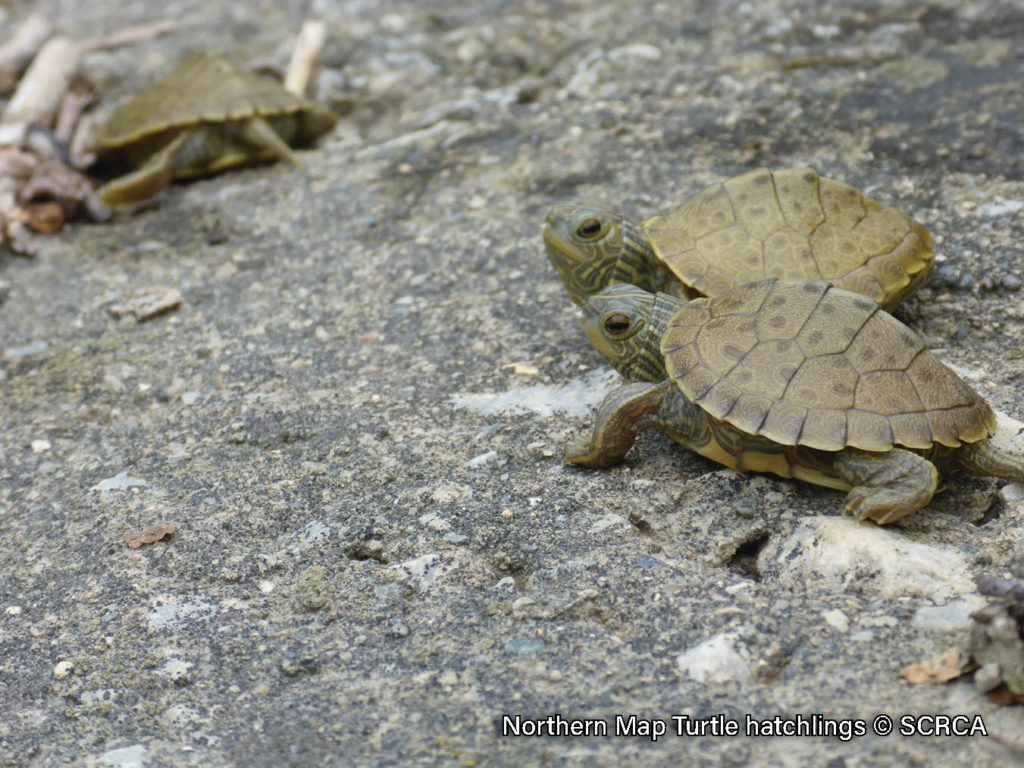
Picture of two Northern Map Turtle hatchlings on a riverbank. The turtle has a brown shell with a yellow contour line pattern, a ridge down the midline of its shell, and the back edge is serrated. It has yellow lines on its neck and a yellow spot behind its eye.

Threats to the Northern Map Turtle

Major threats to Northern Map Turtles include mortality from boat collisions and death caused through commercial fisheries bycatch. Shoreline development and activities that modify natural flow regimes and sediment transport reduce the amount of habitat needed for nesting, basking, foraging, and hibernation. Unnaturally high predation rates by mammalian egg predators, especially raccoons, decreases the number of young turtles being added to the population, threatening the persistence of their populations. Since Map Turtles have a specialized diet, threats like siltation and pollution that impact molluscs and other benthos also threaten Map Turtles.

Picture of a subadult female Northern Map Turtle. The turtle has a brown shell with a yellow contour line pattern, a ridge down the midline of its shell, and the back edge is serrated. It has yellow lines on its neck and a yellow spot behind its eye.
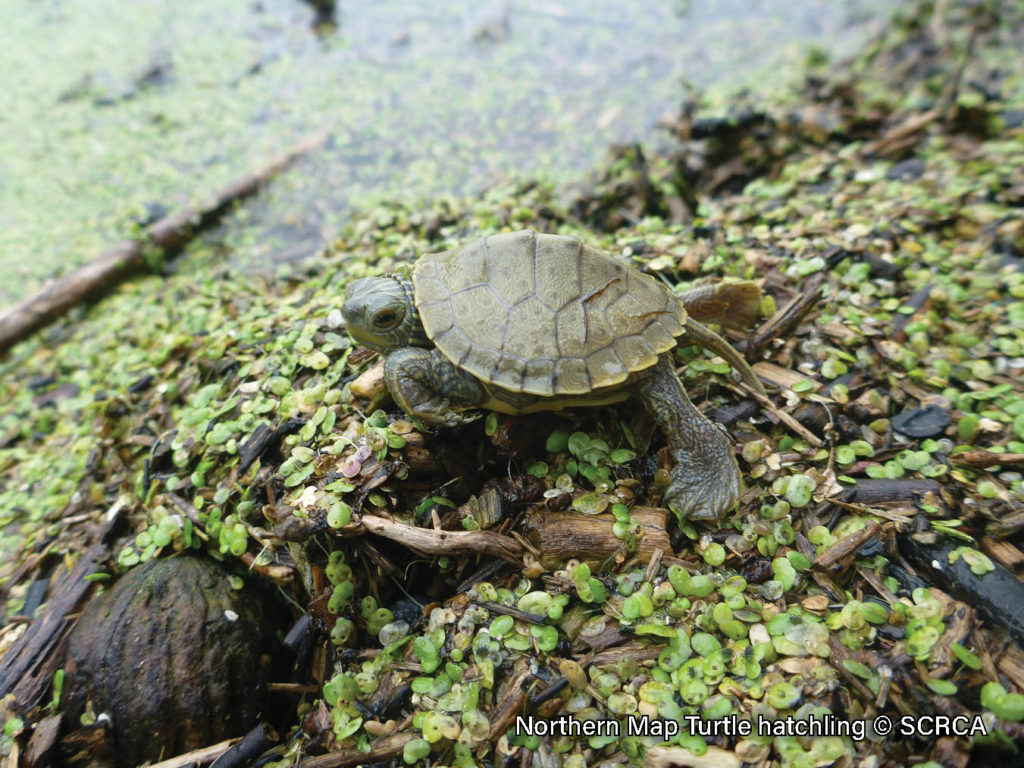
Picture of a Northern Map Turtle hatchling on a riverbank. The turtle has a brown shell with a yellow contour line pattern, a ridge down the midline of its shell, and the back edge is serrated. It has yellow lines on its neck and a yellow spot behind its eye.
Picture of eight Northern Map Turtle hatchlings on a riverbank entering the water. The turtle has a brown shell with a yellow contour line pattern, a ridge down the midline of its shell, and the back edge is serrated. It has yellow lines on its neck and a yellow spot behind its eye.
Picture of five Northern Map Turtle hatchlings on a riverbank entering the water. The turtle has a brown shell with a yellow contour line pattern, a ridge down the midline of its shell, and the back edge is serrated. It has yellow lines on its neck and a yellow spot behind its eye.
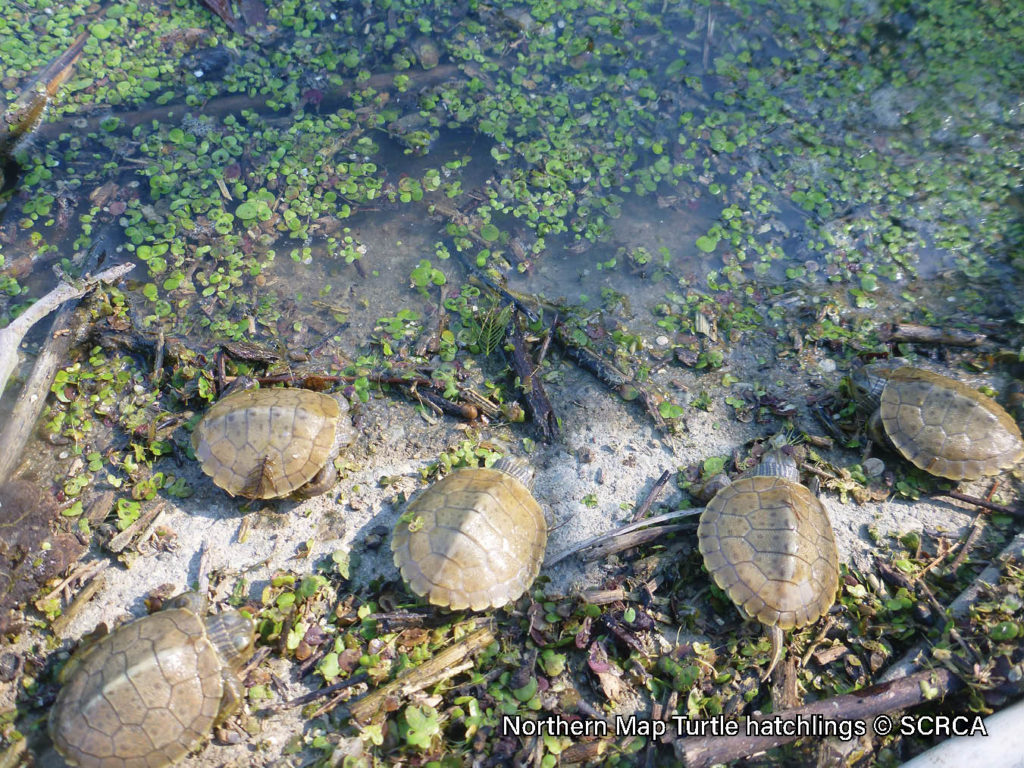
Picture of three Northern Map Turtle hatchlings on a riverbank. The turtle has a brown shell with a yellow contour line pattern, a ridge down the midline of its shell, and the back edge is serrated. It has yellow lines on its neck and a yellow spot behind its eye.
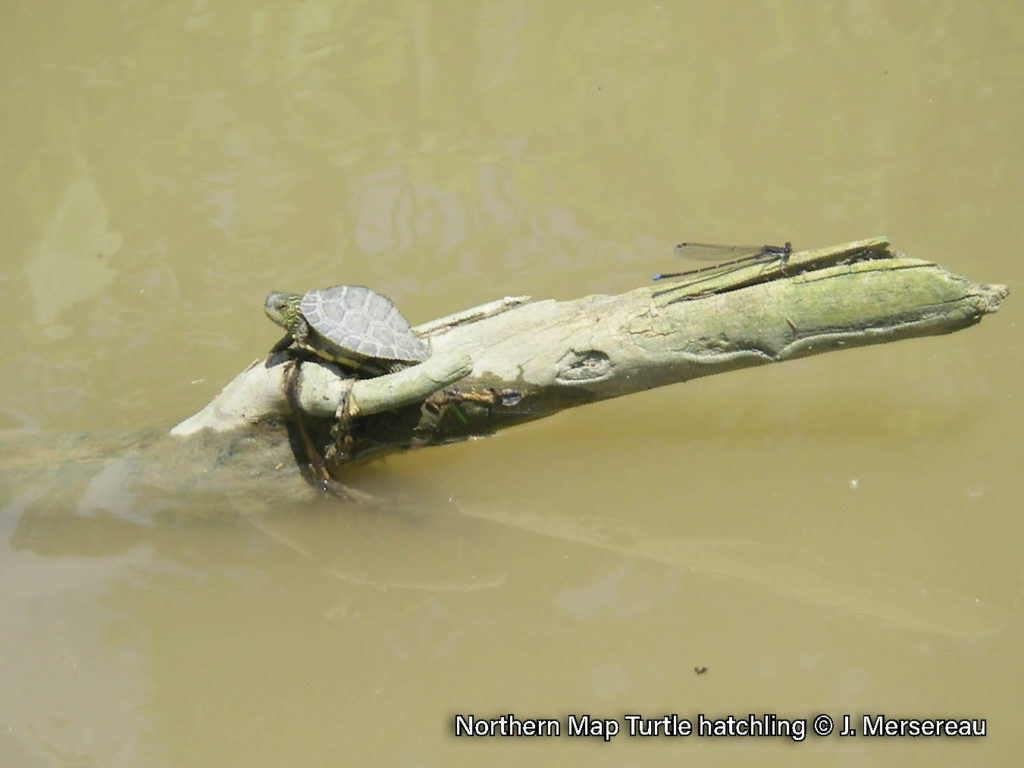
Picture of a Northern Map Turtle hatchling basking on a small log in a river with a damselfly. The turtle has a brown shell with a yellow contour line pattern, a ridge down the midline of its shell, and the back edge is serrated. It has yellow lines on its neck and a yellow spot behind its eye.

Turtles at Risk

  • SAR in the Sydenham
  • Mussels
  • Fishes
  • Snakes
  • Turtles
    • Blanding’s Turtle
    • Midland Painted Turtle
    • Northern Map Turtle
    • Snapping Turtle
    • Spiny Softshell
Test Your ID Skills!
Report a Turtle Sighting
Check out our latest newsletter! Download

© 2026 · St. Clair Region Conservation Authority - The Sydenham River Watershed

  • Privacy

Press Enter to search · Esc to close