Snapping Turtle
Chelydra serpentina


Chelydra serpentina
For 90 million years, the prehistoric and relatively unchanged figure of the Snapping Turtle has lived in the wetlands of North America. These magnificent turtles have watched the rise and fall of the dinosaurs and witnessed the dramatic and extensive loss of wetland habitat in Ontario. The Snapping Turtle is Canada’s largest freshwater turtle and largest reptile, weighing up to 35lbs with a carapace (upper shell) reaching up to 50cm in length.
The large carapace ranges in colour from black to olive and is characterized by three low ridges down its length that smooth with age, a serrated rear margin, and is often covered in a layer of green algae. The plastron (lower shell), which resembles a small X, is significantly reduced on a Snapping Turtle compared to other turtles. They have a broad head, a characteristic hooked upper jaw, and a long neck. Their long, distinctive tail has elevated triangular scales, reminiscent of the iconic Stegosaurus.
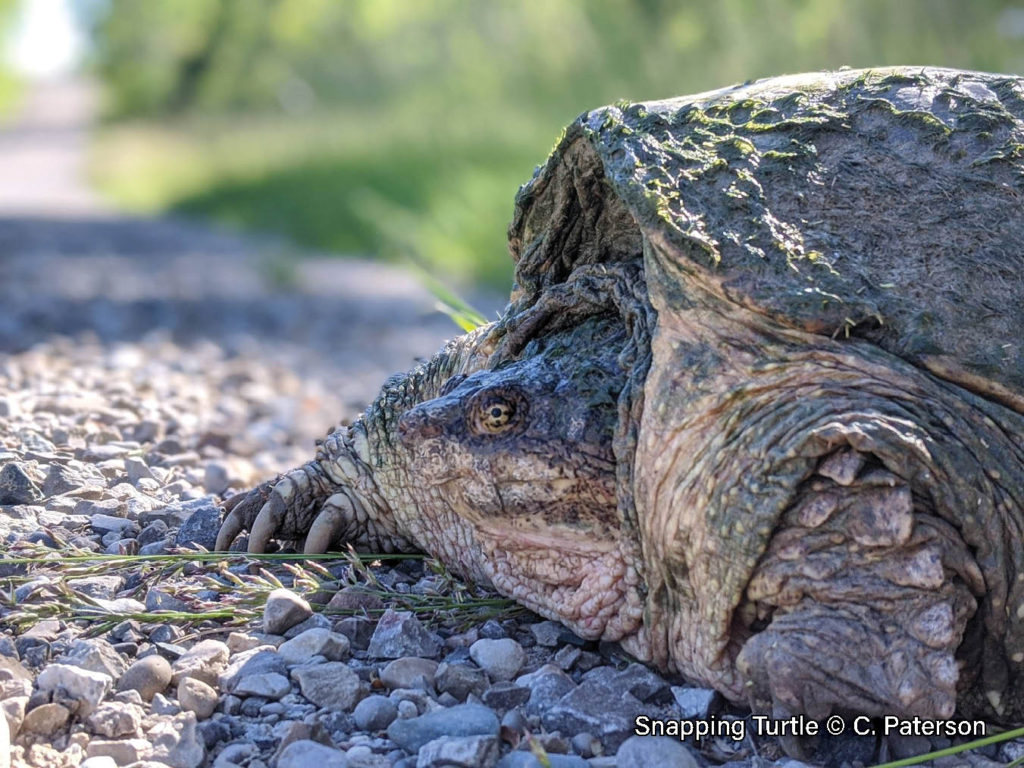
Unlike many other turtle species, the Snapping Turtle is unable to retreat into the safety of its shell, leaving its head and powerful limbs exposed. When threatened on land, it relies on an aggressive behavioural display where it strikes and uses its jaws in a snapping motion to deter predators and other potential threats. When disturbed in water, it will retreat to deeper water or hide in the sediment.

Snapping Turtles are a large, slow-growing, long-lived species – more northern populations have a delayed maturity at 15-20 years and can reach a maximum age of over 100 years. Even small increases in adult mortality have a significant, lasting impact on populations.
Snappers are omnivorous and highly opportunistic, consuming both live prey and carrion (dead animals). Their extensive diet can include algae, plants, snails, crayfish, mussels, fish, frogs, salamanders, snakes, other turtles, and even shorebirds or small mammals. Snapping Turtles actively forage for food but will also lay in ambush, blending into their surrounding environment by remaining motionless, rapidly extending their long necks to catch unsuspecting prey.
Snapping Turtles play an important role in the ecosystem. As omnivores, they are the cleanup crew of wetlands and other aquatic habitats as they eat dead fish and other carrion. They also feed on aquatic plants and carve out paths through dense vegetation opening up habitat that is used by fish, amphibians, and other reptiles.

While found throughout southern Ontario in almost any freshwater habitat, established populations are most often found in ponds, wetlands, slow streams, and shallow bays. The Snapping Turtle prefers slow-moving water with a soft mud bottom and abundant aquatic vegetation, often burrowing into the mud leaving only their nose exposed to breathe.
A Misunderstood Species
Unfortunately Snapping Turtles are often demonized through exaggerated tales of their ferocious behaviour and voracious consumption of sport fish and waterfowl, which leads to human persecution and mistreatment of this prehistoric species. Sadly, a 2007 study in southwestern Ontario by Ashley et al., which used decoy Snapping Turtles and Eastern Foxsnakes, found that 1 in 40 drivers deliberately hit these reptiles on roads. Due to their long lifespan, late age of maturity, and low reproductive success, the loss just a few adults has a significant negative impact on their respective turtle and snake populations.
If you see a turtle or snake trying to cross the road and it is safe to do so, lend them a hand by slowing down, pulling over, and helping them across the road in the direction they were travelling.
The Snapping Turtle is found in North America and has a relatively wide distribution from southeastern Saskatchewan to Nova Scotia, south to Texas. In Ontario, they are restricted to the central and southern portion of the province as the northern parts of Ontario do not get warm enough for successful egg development.

The long lifespan, late age of maturity (15 to 20 years), and slow reproduction rate make Snapping Turtle populations vulnerable from the loss of even a few mature individuals. Activities that lead to unnecessary fatalities like road mortality, illegal harvesting, and poaching pose serious threats to populations. Further threats include the conversion of aquatic habitats for urban development and agriculture, increase in human subsidized predators like raccoons, boat collisions, chemical contamination, and human persecution. The cumulative effect of these threats has led to the listing of this robust and ancient animal as a species at risk.
© 2026 · St. Clair Region Conservation Authority - The Sydenham River Watershed
Press Enter to searchEsc to close


