Blanding’s Turtle
Emydoidea blandingii


Emydoidea blandingii
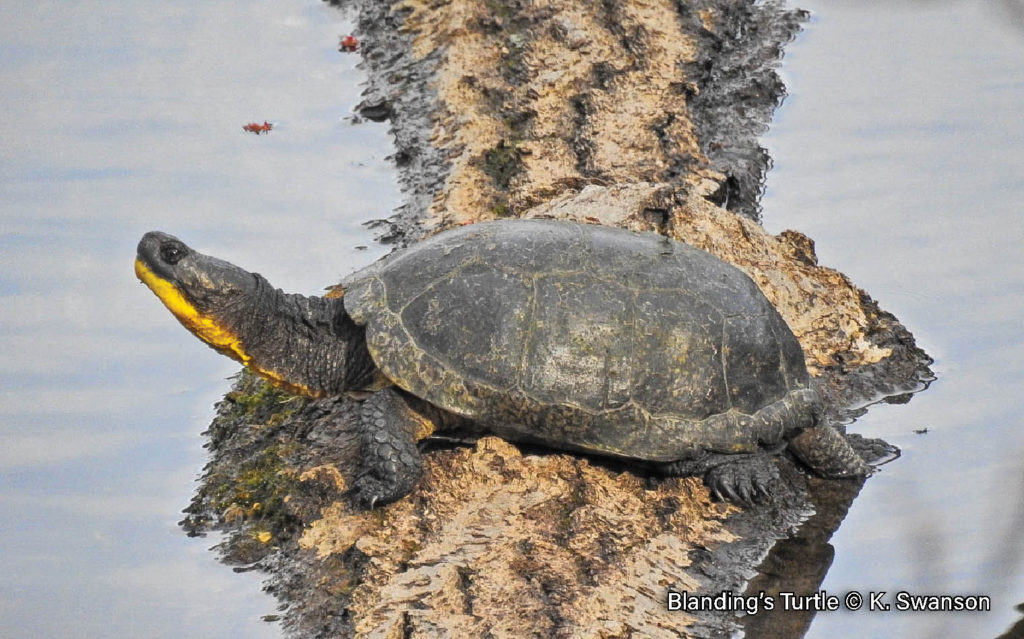
The Blanding’s Turtle is one of the province’s most striking species with its dark shell and vibrant yellow throat. They are a medium sized turtle with a smooth, highly domed carapace (upper shell) that ranges in colour from brown to black and is flecked with yellow spots. They have a hinged plastron (lower shell) that allows them to safely retract their head and legs and close their shell at the first sign of danger.
Blanding’s have an impressively long lifespan – individuals over 80 years old have been documented in the wild. In its northern range, adults can take 25 years to reach sexual maturity, making this species one of the latest maturing turtles in Ontario. Since they are so long-lived and late to mature, each individual adult is vital to the population.
Blanding’s Turtles are omnivorous, they feed on aquatic vegetation as well as a wide selection of prey items including crayfish, fish, worms, leeches, snails, slugs, frogs, and both aquatic and terrestrial insects.

Listen to the traditional Anishinaabe story of “The Turtle with the Sun Under Its Chin” as shared by Toronto Zoo First Nations Conservation Steward, Taylor Tabobondung.
Although they are largely aquatic and can be found in the shallow, quiet, vegetated waters of inland and coastal wetlands, the Blanding’s Turtle is also highly mobile, spending a significant amount of time on land. They have strong fidelity to their residence wetlands but can travel up to 7km between different aquatic and terrestrial habitats within their home range in search of mates and seasonally available resources. During the spring and summer months, Blanding’s Turtles utilize both aquatic and terrestrial habitats, particularly wetlands and upland forests, for mating, nesting, thermoregulation, and foraging. During the harsh winter months, the Blanding’s Turtle retreats to the waters of wetlands, streams, shorelines, or even roadside ditches to overwinter submerged beneath the water’s surface.
Blanding’s Turtles are found in eastern North America, largely around the Great Lakes Basin. They have one of the smallest global ranges of North American turtles, with 20% of their global range occurring in Canada in the southern parts of Ontario, Quebec, and Nova Scotia. Across its range in Canada and the US, the Blanding’s Turtle occurs in isolated subpopulations and is considered at risk.
In Canada, Blanding’s occur in small, discontinuous subpopulations with most appearing to consist of less than 150 adults. In southwestern Ontario, the subpopulations are believed to be severely fragmented due to a significant lack of remaining habitat and little connectivity between the habitat that does exist.

As with many of Ontario’s turtle species, the impact of egg predation, by raccoons in particular, and vehicle mortality is significant. The illegal collection of eggs, hatchlings, and adults for sale and distribution within the pet, food, and medicine trades are further negatively impacting populations. A combination of habitat loss, fragmentation, and degradation, particularly from wetland alteration and development, is rapidly reducing the amount of habitat available that the Blanding’s Turtle requires for various aspects of its life cycle. The spread of invasive Phragmites, a non-native reed grass that forms dense stands, is another threat that is resulting in a loss of habitat.
The Committee on the Status of Endangered Wildlife in Canada (COSEWIC) up-listed the Blanding’s Turtle from Threatened, as assessed in 2005, to Endangered in 2016.
The 2016 Blanding’s Turtle COSEWIC Assessment and Status Report explains that:
Quantitative analyses estimate that the total number of mature individuals in [the Great Lakes/St. Lawrence] population has declined >60% over the last three generations (due to large-scale wetland drainage after European arrival) and will decline 50% over the next three generations because of road mortality alone.”
Every June, members of the local community report sightings of nesting turtles to the St. Clair Region Conservation Authority (SCRCA) but 2021 was the first year a nesting Blanding’s Turtle was reported. SCRCA biologists worked with the landowner that called in the report to locate the nest and determined that it was under imminent threat. The eggs were collected by biologists and incubated with the appropriate permits through the SCRCA’s Captive Hatch and Release Program. Turtle nests have a low success rate due to many factors, one of the largest is the growing populations of egg predators that do well in human impacted landscapes including raccoons, skunks, coyotes, and opossums. After incubating for about 60 days, the young Blanding’s Turtle hatchlings were released back at their original nest site.

© 2026 · St. Clair Region Conservation Authority - The Sydenham River Watershed
Press Enter to searchEsc to close