Salamander Mussel
Simpsonaias ambigua


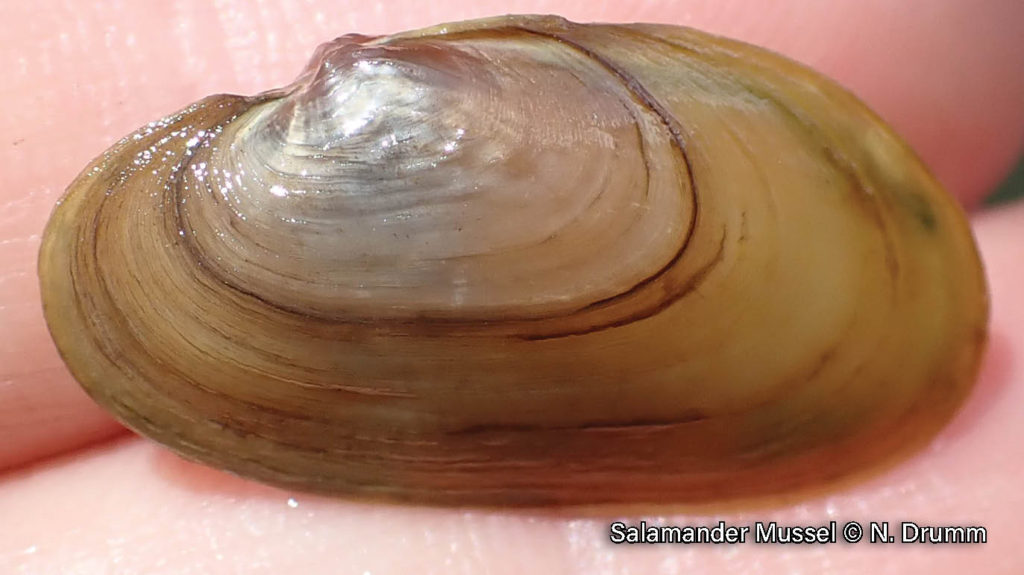
The Salamander Mussel (formerly known as the Mudpuppy Mussel) is one of the most unique and rare mussels found in the Sydenham. This small mussel can be distinguished from other species by its rayless, yellowish-tan to dark brown elliptical shell that grows to a maximum of 4cm. Another identifying feature that can be used for empty shells is that the anterior portion of its valve is thickened along the lower edge.


Like all native freshwater mussels, a host is required for Salamander Mussel glochidia to attach and metamorphose into juvenile mussels. Unlike other unionid mussels in the Sydenham, it does not use a fish host during its lifecycle, instead (as you may have guessed from its name), it uses an amphibian as its host – the Mudpuppy salamander.
A Unique Mussel Host: The Mudpuppy
The Mudpuppy is a large, fully aquatic salamander that can grow up to half a metre in length, they are grey to brown with dark spots and a lightly coloured belly. They have four toes on each foot. The Mudpuppy is adorned with feathery, vibrant red external gills and spend their life navigating the depths of lakes, rivers, and streams. They feed on benthic worms and insects, fish eggs, crayfish, and small fish. Mudpuppies inhabit areas with flat rocks, submerged logs, and gravel substrate, features that are consistent with habitat requirements of the Salamander Mussel. They are mainly nocturnal, spending most of the day under rocks. Mudpuppies are active year-round, including the winter and are often caught by anglers during this time of year.

The Salamander mussel is found in shallow, swift moving waters of medium to large rivers or lakes buried in sand or silt under large flat rocks. They can also be found in mud or gravel bars. These are areas where their host, the Mudpuppy salamander, takes cover to nest or shelter.
The East Sydenham River has the only known population of Salamander Mussel in Canada, which is considered a globally threatened species.
Between 2001 and 2011, 27 Salamander Mussels were observed at six sites through targeted surveys undertaken by DFO as well as during a training workshop and graduate student research. As of 2011, only 59 live Salamander Mussels had ever been recorded on the Sydenham.
Surveys of a 4.5km stretch of the East Sydenham River conducted by SCRCA in 2020 recorded 1,689 live mussels, of which, only one live Salamander Mussel was found.
The Salamander Mussel is threatened by declining habitat quality, siltation, and pollution due to intensive land use including agriculture and urban development. Since these mussels are host specialists, as they only use the Mudpuppy as a host, they are also threatened by threats to the Mudpuppy. Both the Salamander Mussels and the Mudpuppy are sensitive to poor water quality from pollution carried by overland runoff such as herbicides, pesticides, nutrients, and road salts. They are also susceptible to lampricides that are used to control the invasive Sea Lamprey.
© 2026 · St. Clair Region Conservation Authority - The Sydenham River Watershed
Press Enter to searchEsc to close