Round Hickorynut
Obovaria subrotunda


Obovaria subrotunda
The Round Hickorynut is a small mussel that reaches a maximum length of about 6cm. They can range in colour from yellowish or greenish brown to a warm dark brown with a band on their posterior slope that is distinctly lighter. Their shell is thick, inflated and circular.
The Round Hickorynut prefers medium to large rivers or lakes with steady flows and sand or gravel substrate.
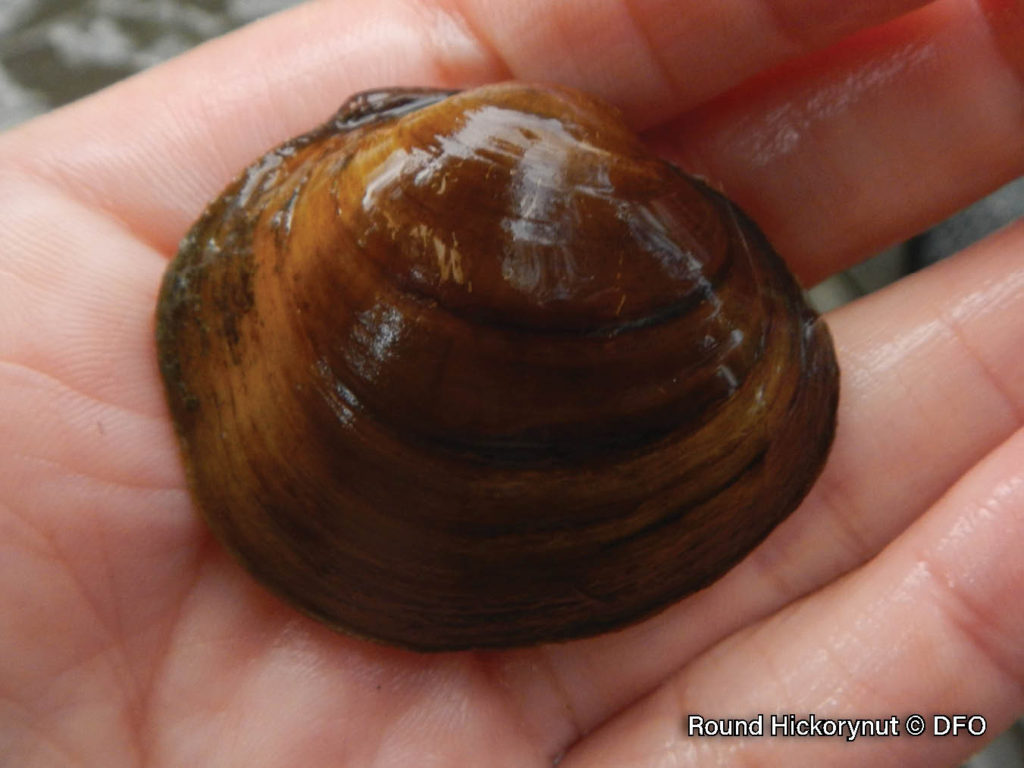
The Round Hickorynut is found in the Ohio River system in the US and the Lake St. Clair drainage in Canada. It is a rare species that has experienced significant population declines – it has been lost from 90% of its former range in Canada. It has been lost from the Detroit, Grand and Thames rivers as well as Lake Erie and the offshore waters of Lake St. Clair.
There are over 5,000 mussel records in the SCRCA database for the St. Clair watershed but only 7 of these records are for the Round Hickorynut mussel. Six of the records come from the East Branch of the Sydenham River and one from Mitchell’s Bay. The most recent record is from 1991, which means none of SCRCA’s current biologists have had the luck to encounter one of these mussels in the wild. The Sydenham River population has significantly declined and is likely close to extirpation.
The only significant population of Round Hickorynut left in Canada occurs in the shallow waters of the St. Clair River Delta, but it is not known if the population will continue to survive.
Invasive species are contributing to Round Hickorynut decline. Particularly concerning is the potential impact of dreissenid mussels (Zebra and Quagga) and Round Goby in the Sydenham River. Until recently, none of these invasive species inhabited the rich mussel riffles of East Branch of the Sydenham River. Dreissenid mussels continue to occur only in the lower portion of the Sydenham River. Unfortunately, researchers detected Round Goby in the East Branch in 2007 and the species’ range continues to expand since that initial discovery. In 2020, St. Clair Conservation Authority biologists confirmed the presence of Round Goby from Dawn Mills to Strathroy’s Head Street dam.


The Round Goby expansion in the Sydenham River is bad news for the Round Hickorynut mussel because the mussel’s complex life cycle is susceptible to disruption by invaders. Researchers believe that the endangered Eastern Sand Darter is a possible fish host for the Round Hickorynut glochidia (larval stage). If this is the case, any declines in the Eastern Sand Darter abundance is likely to adversely impact Round Hickorynut mussel. Unfortunately, in the summer 2020 field season, SCRCA biologists noted lower abundances of the Eastern Sand Darter.
The continued expansion of Round Goby in the East Branch of the Sydenham River, coupled with lower detections in catch per unit effort of Eastern Sand Darter could be another blow to this mussel that is just barely hanging on in the Sydenham River. Stay tuned for more information on SCRCA’s 2020-21 fish monitoring project.

According to the 2003 COSEWIC assessment report:
This species has been lost from about 90% of its former range in Canada. Populations in the Grand and Thames rivers are extirpated and populations in the Sydenham River are declining, all due to the combined effects of pollution and agricultural impacts. Most of the Great Lakes populations have been lost due to impacts of the zebra mussel, and the remaining population in the St. Clair delta near Walpole Island may be at risk. If the Eastern Sand Darter were the host of this species, then the decline of this threatened fish would affect the mussel’s survival.”
© 2026 · St. Clair Region Conservation Authority - The Sydenham River Watershed
Press Enter to searchEsc to close