Skip to content
  • Biodiversity
    • Why is Biodiversity Important?
    • Threats to Biodiversity
    • What are Species at Risk?
    • Recovery Planning
    • Environmental Monitoring
  • Species at Risk
    • Species at Risk
      • SAR in the Sydenham
      • Mussels
      • Fishes
      • Snakes
      • Turtles
    • Mussels
      • Eastern Pondmussel
      • Fawnsfoot
      • Kidneyshell
      • Lilliput
      • Mapleleaf
      • Northern Riffleshell
      • Purple Wartyback
      • Rainbow
      • Rayed Bean
      • Round Hickorynut
      • Round Pigtoe
      • Salamander Mussel
      • Snuffbox
      • Threehorn Wartyback
      • Wavy-rayed Lampmussel
    • Fishes
      • Blackstripe Topminnow
      • Eastern Sand Darter
      • Grass Pickerel
      • Northern Madtom
      • Northern Sunfish
      • Pugnose Minnow
      • Pugnose Shiner
      • River Darter
      • Silver Lamprey
      • Spotted Sucker
    • Snakes
      • Eastern Foxsnake
      • Eastern Hog-nosed Snake
      • Eastern Milksnake
    • Turtles
      • Blanding’s Turtle
      • Midland Painted Turtle
      • Northern Map Turtle
      • Snapping Turtle
      • Spiny Softshell
  • Stewardship
    • Healthy Watersheds Program
      • Sydenham Phosphorus Reduction Initiative
    • Managing Phosphorus
    • Phosphorus StoryMap
    • Reducing Pollution in Runoff
    • Best Management Practices Resources
  • Stories
  • Get Involved
    • What Can I Do?
    • Take the Stewardship Survey
    • Test Your ID Skills!
    • Report a Turtle Sighting
  • Resources
  • Contact Us
Sydenham River WatershedSydenham River Watershed
  • Biodiversity
    • Why is Biodiversity Important?
    • Threats to Biodiversity
    • What are Species at Risk?
    • Recovery Planning
    • Environmental Monitoring
  • Species at Risk
    • Species at Risk
      • SAR in the Sydenham
      • Mussels
      • Fishes
      • Snakes
      • Turtles
    • Mussels
      • Eastern Pondmussel
      • Fawnsfoot
      • Kidneyshell
      • Lilliput
      • Mapleleaf
      • Northern Riffleshell
      • Purple Wartyback
      • Rainbow
      • Rayed Bean
      • Round Hickorynut
      • Round Pigtoe
      • Salamander Mussel
      • Snuffbox
      • Threehorn Wartyback
      • Wavy-rayed Lampmussel
    • Fishes
      • Blackstripe Topminnow
      • Eastern Sand Darter
      • Grass Pickerel
      • Northern Madtom
      • Northern Sunfish
      • Pugnose Minnow
      • Pugnose Shiner
      • River Darter
      • Silver Lamprey
      • Spotted Sucker
    • Snakes
      • Eastern Foxsnake
      • Eastern Hog-nosed Snake
      • Eastern Milksnake
    • Turtles
      • Blanding’s Turtle
      • Midland Painted Turtle
      • Northern Map Turtle
      • Snapping Turtle
      • Spiny Softshell
  • Stewardship
    • Healthy Watersheds Program
      • Sydenham Phosphorus Reduction Initiative
    • Managing Phosphorus
    • Phosphorus StoryMap
    • Reducing Pollution in Runoff
    • Best Management Practices Resources
  • Stories
  • Get Involved
    • What Can I Do?
    • Take the Stewardship Survey
    • Test Your ID Skills!
    • Report a Turtle Sighting
  • Resources
  • Contact Us

Snuffbox

Home Species at Risk in the SydenhamMusselsSnuffbox

Snuffbox

Epioblasma triquetra

COSEWIC: Endangered
SARA: Endangered
SARO: Endangered

Species Description

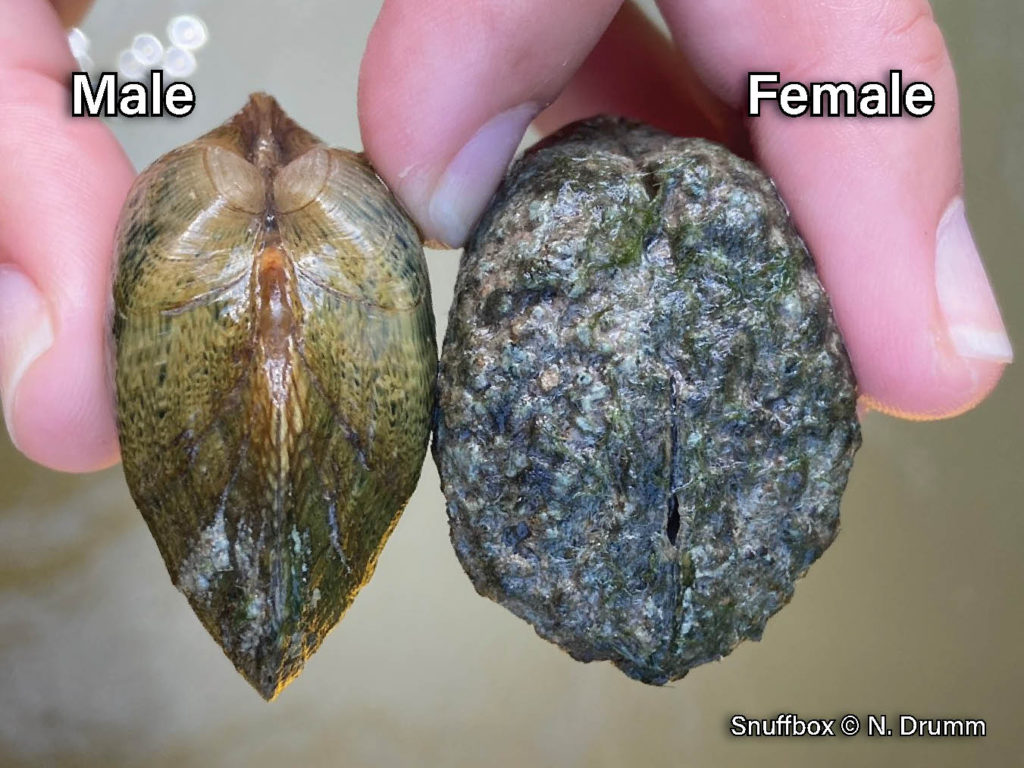
Beneath the waters of the Sydenham River lives a unique and rare mussel species known as the Snuffbox. There are few mussels that share resemblance to the Snuffbox – it is a small, triangular mussel that grows to a maximum of 7.5cm and it has a strong posterior ridge. The Snuffbox’s thick, yellow shell is decorated with dark green rays and blotches that resemble dripping paint, which could lead one to believe that each one was hand painted. They are sexually dimorphic, meaning the males and females look different, the females are smaller with shells that are more inflated and slightly more elongated. The bottom edge of the shell is curved in males whereas females have a small indent and denticles on the ventral margin of their shell.

The uniqueness of the Snuffbox does not end with its appearance, it has also adapted a fascinating reproductive strategy.

Picture of a Snuffbox mussel, a small, triangular mussel with an inflated shell that has a posterior ridge and is yellowish-brown with green rays that look like dripping paint.
Picture of a female (top) and male (bottom) Snuffbox mussel, a small, triangular mussel with an inflated shell that has a posterior ridge and is yellowish-brown with green rays that look like dripping paint. The female is more elongate than the male.
Picture of a male (left) and female (right) Snuffbox mussel, a small, triangular mussel with an inflated shell that has a posterior ridge and is yellowish-brown with green rays that look like dripping paint. The female is more inflated than the male.
Picture of a male (left) and female (right) Snuffbox mussel, a small, triangular mussel with an inflated shell that has a posterior ridge and is yellowish-brown with green rays that look like dripping paint. The female is more inflated than the male and has denticles along the ventral margin.

Lifecycle: Catch and Release Fishing

Like the other native freshwater mussels in the Sydenham, the Snuffbox requires a host fish to nourish their parasitic larvae, known as glochidia, and help them disperse to new areas of habitat.

Snuffbox and Northern Riffleshell are the only two species in the Sydenham that belong to the genus Epioblasma, which use a unique strategy to ensure their glochidia reach their host – they actually capture their host fish.

Hand-drawn diagram of the Snuffbox Mussel Lifecycle by Erin Carroll, labels read: 1. Sperm from an adult male Snuffbox mussel fertilize the eggs of an adult female; 2. The female Snuffbox snaps closed on the snout of a Logperch and expels larvae onto the fish’s gills; 3. Mussel larvae (glochidia) develop into juvenile mussels, let go of the host fish, and drop to the river bottom; 4. Juvenile mussels mature into adult mussels.

The Snuffbox is a host specialist and has evolved a unique relationship with the native Logperch, a small, bottom-dwelling darter. Logperch feed along the river bottom on aquatic insect larvae, rolling stones in search of prey. On occasion, an unsuspecting Logperch will roll a female Snuffbox, who then snaps closed on the Logperch’s long snout, the female mussels have serrations on the edge of their shell, known as denticles, that help the mussel hold on to the host fish. The Logperch has evolved alongside the Snuffbox to have a strong, reinforced skull that can withstand the mussel clamping down on it. With the Logperch firmly grasped, the Snuffbox then expels glochidia, which attach to the fish’s gills. After several weeks of absorbing nutrients, the young mussels detach from their host and float down to the substrate below. The Snuffbox, like other unionids, can only move small distances so they rely on host fish species to carry the next generation to new parts of the river.

Video: A female Snuffbox capturing a Logperch (video by M.C. Barnhart, Missouri State University)

Distribution in the Sydenham

Snuffbox can be found in shallow riffle areas with clean, clear, fast-flowing water with a substrate consisting of gravel, sand, and rocks. They often bury themselves within the substrate or with only their posterior ridge exposed.

The Snuffbox is only found in two rivers in Canada, it is limited to a 93km stretch of the East Sydenham River and five sites in a 91km stretch of the Ausable River. Although, historically, the Snuffbox could also be found in the Grand, Niagara, and Thames rivers, Lake St. Clair and Lake Erie.

In 2020, the SCRCA surveyed mussels from a 4.5km section of the East Sydenham River – known Snuffbox habitat. Of the 1,689 live mussels detected, only 10 live Snuffboxes were found.

The Sydenham watershed contains critical habitat for the Snuffbox, which means that habitat in the Sydenham is considered “necessary for the survival or recovery” of this Species at Risk.

Threats to the Snuffbox

The Snuffbox is considered globally vulnerable and has been lost from 60% of its former range. Based on the change in catch rates over time, populations in the East Sydenham River seem to be declining. Like other unionids, Snuffbox face several threats, the most significant being siltation and pollution from agricultural and urban runoff, sediment can suffocate mussel beds. Invasive species like the Round Goby threaten mussels by feeding on juvenile mussels as well as impacting their host fish populations. The introduction of Zebra and Quagga mussels has also had devastating impacts on freshwater mussel communities in the Great Lakes.

Picture of a Snuffbox mussel, a small, triangular mussel with an inflated shell that has a posterior ridge and is yellowish-brown with green rays that look like dripping paint.

Mussels at Risk

  • SAR in the Sydenham
  • Mussels
    • Eastern Pondmussel
    • Fawnsfoot
    • Kidneyshell
    • Lilliput
    • Mapleleaf
    • Northern Riffleshell
    • Purple Wartyback
    • Rainbow
    • Rayed Bean
    • Round Hickorynut
    • Round Pigtoe
    • Salamander Mussel
    • Snuffbox
    • Threehorn Wartyback
    • Wavy-rayed Lampmussel
  • Fishes
  • Snakes
  • Turtles
Test Your ID Skills!
Check out our latest newsletter! Download

© 2026 · St. Clair Region Conservation Authority - The Sydenham River Watershed

  • Privacy

Press Enter to search · Esc to close