• Biodiversity
    • Why is Biodiversity Important?
    • Threats to Biodiversity
    • What are Species at Risk?
    • Recovery Planning
    • Environmental Monitoring
  • Species at Risk
    • Species at Risk
      • SAR in the Sydenham
      • Mussels
      • Fishes
      • Snakes
      • Turtles
    • Mussels
      • Eastern Pondmussel
      • Fawnsfoot
      • Kidneyshell
      • Lilliput
      • Mapleleaf
      • Northern Riffleshell
      • Purple Wartyback
      • Rainbow
      • Rayed Bean
      • Round Hickorynut
      • Round Pigtoe
      • Salamander Mussel
      • Snuffbox
      • Threehorn Wartyback
      • Wavy-rayed Lampmussel
    • Fishes
      • Blackstripe Topminnow
      • Eastern Sand Darter
      • Grass Pickerel
      • Northern Madtom
      • Northern Sunfish
      • Pugnose Minnow
      • Pugnose Shiner
      • River Darter
      • Silver Lamprey
      • Spotted Sucker
    • Snakes
      • Eastern Foxsnake
      • Eastern Hog-nosed Snake
      • Eastern Milksnake
    • Turtles
      • Blanding’s Turtle
      • Midland Painted Turtle
      • Northern Map Turtle
      • Snapping Turtle
      • Spiny Softshell
  • Stewardship
    • Healthy Watersheds Program
      • Sydenham Phosphorus Reduction Initiative
    • Managing Phosphorus
    • Phosphorus StoryMap
    • Reducing Pollution in Runoff
    • Best Management Practices Resources
  • Stories
  • Get Involved
    • What Can I Do?
    • Take the Stewardship Survey
    • Test Your ID Skills!
    • Report a Turtle Sighting
  • Resources
  • Contact Us
Sydenham River WatershedSydenham River Watershed
  • Biodiversity
    • Why is Biodiversity Important?
    • Threats to Biodiversity
    • What are Species at Risk?
    • Recovery Planning
    • Environmental Monitoring
  • Species at Risk
    • Species at Risk
      • SAR in the Sydenham
      • Mussels
      • Fishes
      • Snakes
      • Turtles
    • Mussels
      • Eastern Pondmussel
      • Fawnsfoot
      • Kidneyshell
      • Lilliput
      • Mapleleaf
      • Northern Riffleshell
      • Purple Wartyback
      • Rainbow
      • Rayed Bean
      • Round Hickorynut
      • Round Pigtoe
      • Salamander Mussel
      • Snuffbox
      • Threehorn Wartyback
      • Wavy-rayed Lampmussel
    • Fishes
      • Blackstripe Topminnow
      • Eastern Sand Darter
      • Grass Pickerel
      • Northern Madtom
      • Northern Sunfish
      • Pugnose Minnow
      • Pugnose Shiner
      • River Darter
      • Silver Lamprey
      • Spotted Sucker
    • Snakes
      • Eastern Foxsnake
      • Eastern Hog-nosed Snake
      • Eastern Milksnake
    • Turtles
      • Blanding’s Turtle
      • Midland Painted Turtle
      • Northern Map Turtle
      • Snapping Turtle
      • Spiny Softshell
  • Stewardship
    • Healthy Watersheds Program
      • Sydenham Phosphorus Reduction Initiative
    • Managing Phosphorus
    • Phosphorus StoryMap
    • Reducing Pollution in Runoff
    • Best Management Practices Resources
  • Stories
  • Get Involved
    • What Can I Do?
    • Take the Stewardship Survey
    • Test Your ID Skills!
    • Report a Turtle Sighting
  • Resources
  • Contact Us

Wavy-rayed Lampmussel

Home Species at Risk in the SydenhamMusselsWavy-rayed Lampmussel

Wavy-rayed Lampmussel

Lampsilis fasciola

COSEWIC: Special Concern
SARA: Special Concern
SARO: Threatened

Species Description

The Wavy-rayed Lampmussel is a medium-sized freshwater mussel that ranges in size from 6 to 10cm. It has a fairly thick, oval shell that is yellow with many thin, wavy green rays. They are sexually dimorphic, meaning the males and females look different – the females have a distended shell, giving them a more rounded appearance than males. They can live for 10 to 20 years and like other mussels, they extract food from the water column through filter feeding.
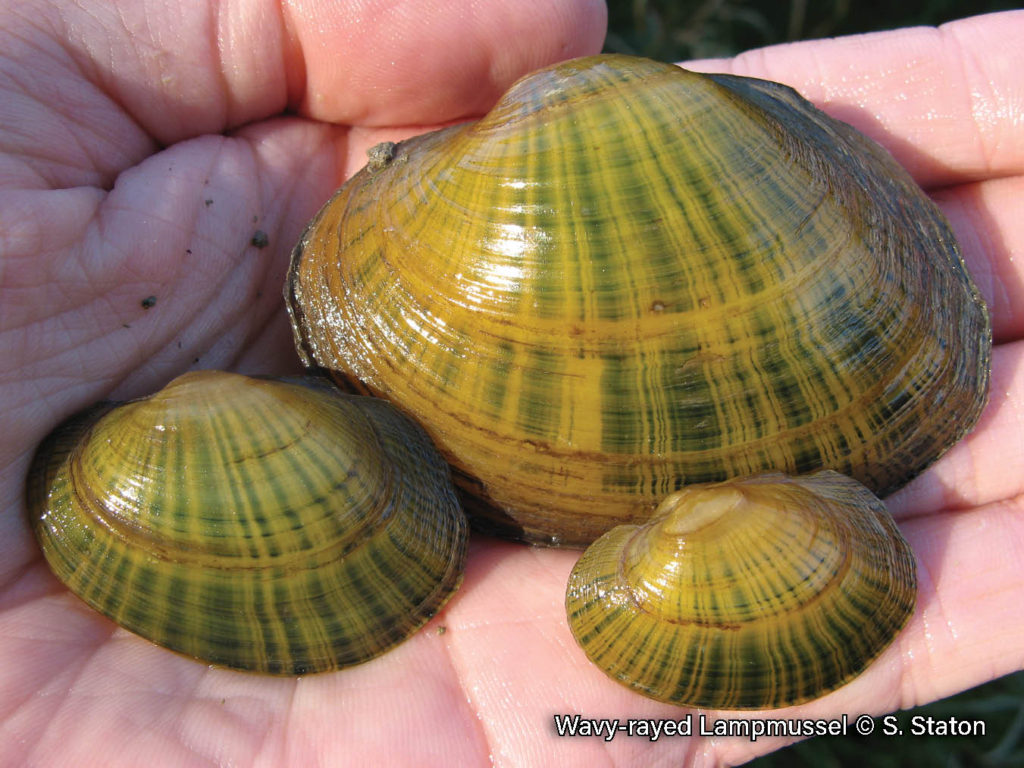
Picture of three Wavy-rayed Lampmussels in a hand, an oval, inflated mussel that has a yellow shell with green rays.

Lifecycle

Like an avid angler, the Wavy-rayed Lampmussel uses a lure to drastically increase its chances of attracting its host fish species. The Wavy-rayed Lampmussel has developed a remarkable lure, resembling a small minnow, a favourite prey item of the Smallmouth Bass. Just as remarkable is the fact that this animal has created a lure in the image of a fish it has never seen through the powerful evolutionary process of natural selection.

As with all unionid mussels, the glochidia must attach to an appropriate host in order to complete their metamorphosis into juvenile mussels. Their host also helps the mussels reach new areas of habitat they would otherwise be unable to reach. When the bass bites at the lure, the mussel releases a plume of its glochidia, which attach to their host.

Video: A Largemouth Bass striking a Lampsilis mussel lure (video by Brett Billings and Ryan Hagerty, USFWS)

Habitat

The Wavy-rayed Lampmussel can be found in small to medium-sized rivers in riffle areas with steady flow, clear water, and sandy to gravelly substrate.

Distribution in the Sydenham

The Wavy-rayed Lampmussel is native to eastern North America and is found in the Ohio and Mississippi river drainages and the Great Lakes basin. In Canada, they were historically found in the waters of Lake St. Clair and western basin of Lake Erie as well as tributaries of lower Lake Huron, Lake St. Clair, Lake Erie, and Lake Ontario. These tributaries include the Maitland, Ausable, Sydenham, Thames, Detroit, Grand, and Niagara rivers. Reproducing populations are now only found in the Maitland, Ausable, Thames, and Grand rivers and the St. Clair River Delta in Bkejwanong Territory. The largest population is in the Grand River.

Clear water may be a critical requirement for successful reproduction, as the Wavy-rayed Lampmussel is a host specialist and uses a lure designed to attract Smallmouth or Largemouth Bass, both of which are visual hunters. The often-cloudy waters of the Sydenham River may help to explain their small population and why the species has only been detected once since 1971. The Wavy-rayed Lampmussel was previously believed to be extirpated from the Sydenham River but it was observed in the river by DFO scientists in 2013.

Threats to the Wavy-rayed Lampmussel

The main threats Wavy-rayed Lampmussels face are declining water and habitat quality as well as invasive species. Declining water quality and habitat availability is resulting from the loss of clean, silt-free riffle habitats, and runoff containing excessive amounts of sediment, pesticides, fertilizers and manure. Influxes of pollutants and pathogens from wastewater treatment and storm water runoff also reduce water quality. Invasive Zebra and Quagga mussels threaten Wavy-rayed populations, particularly in the St. Clair River Delta, as they attach to native mussels, severely limiting their ability to feed, move, and respire.

Mussels at Risk

  • SAR in the Sydenham
  • Mussels
    • Eastern Pondmussel
    • Fawnsfoot
    • Kidneyshell
    • Lilliput
    • Mapleleaf
    • Northern Riffleshell
    • Purple Wartyback
    • Rainbow
    • Rayed Bean
    • Round Hickorynut
    • Round Pigtoe
    • Salamander Mussel
    • Snuffbox
    • Threehorn Wartyback
    • Wavy-rayed Lampmussel
  • Fishes
  • Snakes
  • Turtles
Test Your ID Skills!
Check out our latest newsletter! Download

© 2026 · St. Clair Region Conservation Authority - The Sydenham River Watershed

  • Privacy

Press Enter to search · Esc to close