Eastern Sand Darter
Ammocrypta pellucida


Ammocrypta pellucida
The Eastern Sand Darter is a small member of the family Percidae (Perches and Darters), reaching an average length of 6cm. They are easily distinguished from other darters by their slender and elongate, translucent body. Their back can range in colour from yellow to green usually with a row of spots down the middle. Their sides are pale yellow to silvery with a beautiful golden stripe and smaller spots across their body. Spawning males can develop black pelvic fins and iridescent greenish-blue cheeks.
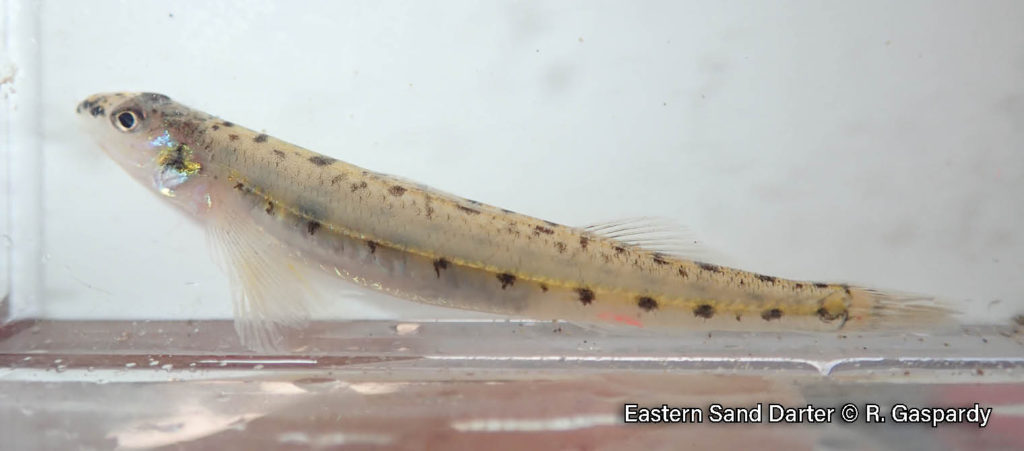
Eastern Sand Darters are found almost exclusively in shallow, sandy-bottomed areas of streams and lakes where they will often bury themselves, usually leaving only their eyes exposed. This unique behaviour is reflected in the Eastern Sand Darter’s scientific name, Ammocrypta, from “ammos” meaning sand and “krypto” meaning hide.
They mainly feed on aquatic insects found on the lake or river bottom. Adult sand darters prefer midge and black fly larvae whereas the diet of juveniles consists of zooplankton as well as a variety of very small insects.
The Eastern Sand Darter is a rare species found in North America in the drainages of the Ohio River, lower Great Lakes, and St. Lawrence River. In Canada, it occurs in southern Quebec and southwestern Ontario.
In Ontario, it is found in Lake St. Clair, Lake Erie, West Lake, Big Creek and in the Grand, Sydenham, Thames and Detroit rivers, with the Thames thought to be home to the largest population in Canada. The Eastern Sand Darter is believed to have been lost from three nearby river systems including the Ausable River, Big Otter Creek, and Catfish Creek.
In the area immediately surrounding the Sydenham watershed, they have been recorded in the nearshore waters of eastern Lake St. Clair including Mitchell’s Bay.
The first recorded observations of Eastern Sand Darter in the Sydenham River were from 1927 at Strathroy, 1929 in Alvinston, and near the mouth of Fansher Creek in 1972. It is still found in the lower reaches of the East Branch but has not been detected in the upper portion of the river between Alvinston and Strathroy in recent years. Biologists believe the fish no longer inhabits the upper reaches, despite this region boasting the sandy habitat the species prefers, indicating threats have driven population decline.

Ontario populations of Eastern Sand Darter are declining throughout the species’ range due to siltation, sand bar removal, dams and channelization, the modification of natural stream flows, pollution, and invasive species. Habitat loss from siltation is believed to be the largest threat as it smothers the sand that they need to bury themselves and their eggs in. Siltation is caused by soils washing off the land due to the loss of riparian vegetation and year-round soil cover, urban and agricultural land use, and stream channel alteration. Pollution from fertilizer and pesticides degrade the water quality. Predation and competition for food and habitat with the invasive Round Goby, another bottom-dwelling fish, is an additional factor than may be contributing to their population decline.
Video by Pinegrove Productions about Eastern Sand Darter and habitat restoration efforts by private landowners and the SCRCA in the Sydenham watershed.
© 2026 · St. Clair Region Conservation Authority - The Sydenham River Watershed