• Biodiversity
    • Why is Biodiversity Important?
    • Threats to Biodiversity
    • What are Species at Risk?
    • Recovery Planning
    • Environmental Monitoring
  • Species at Risk
    • Species at Risk
      • SAR in the Sydenham
      • Mussels
      • Fishes
      • Snakes
      • Turtles
    • Mussels
      • Eastern Pondmussel
      • Fawnsfoot
      • Kidneyshell
      • Lilliput
      • Mapleleaf
      • Northern Riffleshell
      • Purple Wartyback
      • Rainbow
      • Rayed Bean
      • Round Hickorynut
      • Round Pigtoe
      • Salamander Mussel
      • Snuffbox
      • Threehorn Wartyback
      • Wavy-rayed Lampmussel
    • Fishes
      • Blackstripe Topminnow
      • Eastern Sand Darter
      • Grass Pickerel
      • Northern Madtom
      • Northern Sunfish
      • Pugnose Minnow
      • Pugnose Shiner
      • River Darter
      • Silver Lamprey
      • Spotted Sucker
    • Snakes
      • Eastern Foxsnake
      • Eastern Hog-nosed Snake
      • Eastern Milksnake
    • Turtles
      • Blanding’s Turtle
      • Midland Painted Turtle
      • Northern Map Turtle
      • Snapping Turtle
      • Spiny Softshell
  • Stewardship
    • Healthy Watersheds Program
      • Sydenham Phosphorus Reduction Initiative
    • Managing Phosphorus
    • Phosphorus StoryMap
    • Reducing Pollution in Runoff
    • Best Management Practices Resources
  • Stories
  • Get Involved
    • What Can I Do?
    • Take the Stewardship Survey
    • Test Your ID Skills!
    • Report a Turtle Sighting
  • Resources
  • Contact Us
Sydenham River WatershedSydenham River Watershed
  • Biodiversity
    • Why is Biodiversity Important?
    • Threats to Biodiversity
    • What are Species at Risk?
    • Recovery Planning
    • Environmental Monitoring
  • Species at Risk
    • Species at Risk
      • SAR in the Sydenham
      • Mussels
      • Fishes
      • Snakes
      • Turtles
    • Mussels
      • Eastern Pondmussel
      • Fawnsfoot
      • Kidneyshell
      • Lilliput
      • Mapleleaf
      • Northern Riffleshell
      • Purple Wartyback
      • Rainbow
      • Rayed Bean
      • Round Hickorynut
      • Round Pigtoe
      • Salamander Mussel
      • Snuffbox
      • Threehorn Wartyback
      • Wavy-rayed Lampmussel
    • Fishes
      • Blackstripe Topminnow
      • Eastern Sand Darter
      • Grass Pickerel
      • Northern Madtom
      • Northern Sunfish
      • Pugnose Minnow
      • Pugnose Shiner
      • River Darter
      • Silver Lamprey
      • Spotted Sucker
    • Snakes
      • Eastern Foxsnake
      • Eastern Hog-nosed Snake
      • Eastern Milksnake
    • Turtles
      • Blanding’s Turtle
      • Midland Painted Turtle
      • Northern Map Turtle
      • Snapping Turtle
      • Spiny Softshell
  • Stewardship
    • Healthy Watersheds Program
      • Sydenham Phosphorus Reduction Initiative
    • Managing Phosphorus
    • Phosphorus StoryMap
    • Reducing Pollution in Runoff
    • Best Management Practices Resources
  • Stories
  • Get Involved
    • What Can I Do?
    • Take the Stewardship Survey
    • Test Your ID Skills!
    • Report a Turtle Sighting
  • Resources
  • Contact Us

Northern Madtom

Home Species at Risk in the SydenhamFishesNorthern Madtom

Northern Madtom

Noturus stigmosus

COSEWIC: Endangered
SARA: Endangered
SARO: Endangered

Species Description

The Northern Madtom is species of the family Ictaluridae (North American Catfishes) that is rare on both the provincial and global scale. Northern Madtom are distinguished from the 8 other species of catfish in Ontario by their small size (average 8cm in length), stout body shape, and 2-3 dark saddle-shaped markings on the back, which are accompanied by 2 pale, eye-sized spots ahead of the dorsal fin.

Although this fish may be small, it boasts a strong defence against predators (and sometimes the overzealous biologist) as the dorsal and pectoral fins support sharp spines that have poison glands that can cause painful wounds.

Picture of a northern madtom in a hand, a small, benthic, brown fish with large whiskers

Four pairs of the characteristic catfish whiskers, known as barbels, protrude out from the snout. Being a nocturnal benthic feeder, these sensitive whiskers aid in detecting preferred prey items including small aquatic invertebrates like midges, mayflies, and caddisflies.
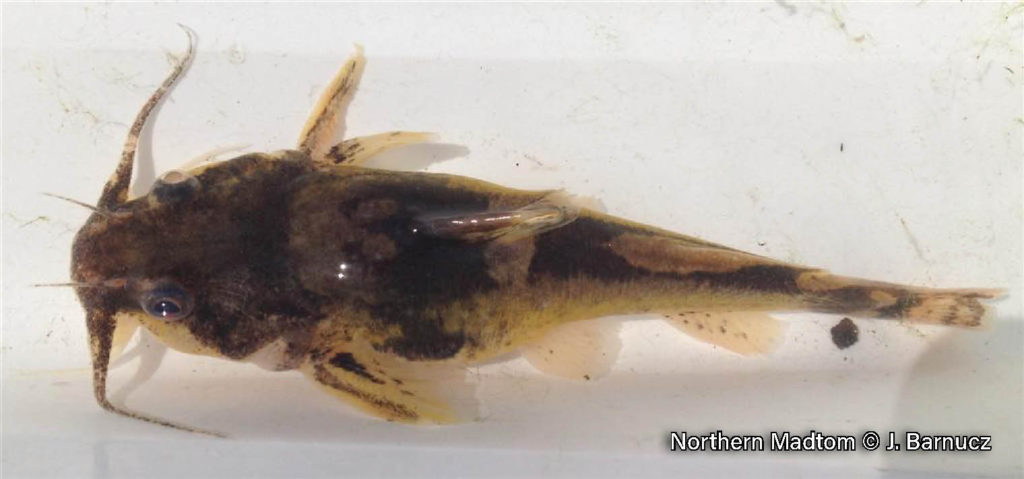
Overhead picture of a northern madtom, a small, benthic, brown fish with large whiskers

They construct nests under flat rocks or burrows and spawn in the summer. Unlike most species of fish, Northern Madtom males guard their eggs and protect their young for a few weeks after they hatch.

Habitat

The Northern Madtom can tolerate a range of habitat conditions. While typically found in large creeks and rivers with a moderate to strong current, they can also occur in lakes. Northern Madtom prefer clear waters with sand, gravel or rocky bottoms but can also be found in slightly turbid water with aquatic vegetation.

“Swimming Tongues”
There are nine species of Ictalurid catfishes in Ontario that are characterized by wide, flat heads, eight barbels (whiskers) around their mouth, an adipose fin, spines in their pectoral and dorsal fins, and lack of scales. They are most active at night and have a sharp sense of taste and smell. They can detect substances in the water at low concentrations as they have taste buds on their body that are densely packed on their barbels. This allows them to find food in dark or turbid waters.

The Channel Catfish, another Ictalurid found in the Sydenham, is the largest species of catfish native to Canada. They have the keenest sense of taste of any vertebrate in the world and, because of this, are referred to as “swimming tongues.”

Picture of a young channel catfish in a viewing box, a silvery catfish with some black spots.

Distribution in the Sydenham

The Northern Madtom is found in the Ohio River, western Lake Erie, and Lake St. Clair drainages. It is critically imperilled in Ontario, Michigan, Ohio, and Illinois and is one of the rarest species of freshwater fish in Ontario. It is only found at four locations in Canada, all of which are in southwestern Ontario, including the Thames, St. Clair, and Detroit rivers as well as Lake St. Clair. Despite targeted sampling by Fisheries and Oceans Canada in recent years, the Northern Madtom has only ever been detected twice in the Sydenham River – once in 1929 near Alvinston and once in 1975 near Florence. The species is considered likely to be extirpated from the watershed.

Picture of a northern madtom on a measuring board, a small, benthic, brown fish with large whiskers

Threats to Northern Madtom

The main threats to the Northern Madtom include habitat destruction, siltation and excessive turbidity, nutrient loadings, toxic compounds, climate change, and competition from non-native fishes such as Round Goby.

Fishes at Risk

  • SAR in the Sydenham
  • Mussels
  • Fishes
    • Blackstripe Topminnow
    • Eastern Sand Darter
    • Grass Pickerel
    • Northern Madtom
    • Northern Sunfish
    • Pugnose Minnow
    • Pugnose Shiner
    • River Darter
    • Silver Lamprey
    • Spotted Sucker
  • Snakes
  • Turtles
Test Your ID Skills!
Check out our latest newsletter! Download

© 2026 · St. Clair Region Conservation Authority - The Sydenham River Watershed

  • Privacy

Press Enter to search · Esc to close