• Biodiversity
    • Why is Biodiversity Important?
    • Threats to Biodiversity
    • What are Species at Risk?
    • Recovery Planning
    • Environmental Monitoring
  • Species at Risk
    • Species at Risk
      • SAR in the Sydenham
      • Mussels
      • Fishes
      • Snakes
      • Turtles
    • Mussels
      • Eastern Pondmussel
      • Fawnsfoot
      • Kidneyshell
      • Lilliput
      • Mapleleaf
      • Northern Riffleshell
      • Purple Wartyback
      • Rainbow
      • Rayed Bean
      • Round Hickorynut
      • Round Pigtoe
      • Salamander Mussel
      • Snuffbox
      • Threehorn Wartyback
      • Wavy-rayed Lampmussel
    • Fishes
      • Blackstripe Topminnow
      • Eastern Sand Darter
      • Grass Pickerel
      • Northern Madtom
      • Northern Sunfish
      • Pugnose Minnow
      • Pugnose Shiner
      • River Darter
      • Silver Lamprey
      • Spotted Sucker
    • Snakes
      • Eastern Foxsnake
      • Eastern Hog-nosed Snake
      • Eastern Milksnake
    • Turtles
      • Blanding’s Turtle
      • Midland Painted Turtle
      • Northern Map Turtle
      • Snapping Turtle
      • Spiny Softshell
  • Stewardship
    • Healthy Watersheds Program
      • Sydenham Phosphorus Reduction Initiative
    • Managing Phosphorus
    • Phosphorus StoryMap
    • Reducing Pollution in Runoff
    • Best Management Practices Resources
  • Stories
  • Get Involved
    • What Can I Do?
    • Take the Stewardship Survey
    • Test Your ID Skills!
    • Report a Turtle Sighting
  • Resources
  • Contact Us
Sydenham River WatershedSydenham River Watershed
  • Biodiversity
    • Why is Biodiversity Important?
    • Threats to Biodiversity
    • What are Species at Risk?
    • Recovery Planning
    • Environmental Monitoring
  • Species at Risk
    • Species at Risk
      • SAR in the Sydenham
      • Mussels
      • Fishes
      • Snakes
      • Turtles
    • Mussels
      • Eastern Pondmussel
      • Fawnsfoot
      • Kidneyshell
      • Lilliput
      • Mapleleaf
      • Northern Riffleshell
      • Purple Wartyback
      • Rainbow
      • Rayed Bean
      • Round Hickorynut
      • Round Pigtoe
      • Salamander Mussel
      • Snuffbox
      • Threehorn Wartyback
      • Wavy-rayed Lampmussel
    • Fishes
      • Blackstripe Topminnow
      • Eastern Sand Darter
      • Grass Pickerel
      • Northern Madtom
      • Northern Sunfish
      • Pugnose Minnow
      • Pugnose Shiner
      • River Darter
      • Silver Lamprey
      • Spotted Sucker
    • Snakes
      • Eastern Foxsnake
      • Eastern Hog-nosed Snake
      • Eastern Milksnake
    • Turtles
      • Blanding’s Turtle
      • Midland Painted Turtle
      • Northern Map Turtle
      • Snapping Turtle
      • Spiny Softshell
  • Stewardship
    • Healthy Watersheds Program
      • Sydenham Phosphorus Reduction Initiative
    • Managing Phosphorus
    • Phosphorus StoryMap
    • Reducing Pollution in Runoff
    • Best Management Practices Resources
  • Stories
  • Get Involved
    • What Can I Do?
    • Take the Stewardship Survey
    • Test Your ID Skills!
    • Report a Turtle Sighting
  • Resources
  • Contact Us

Eastern Hog-nosed Snake

Home Species at Risk in the SydenhamSnakesEastern Hog-nosed Snake

Eastern Hog-nosed Snake

Heterodon platirhinos

COSEWIC: Threatened
SARA: Threatened
COSSARO: Threatened
SARO: Threatened

Species Description

The Eastern Hog-nosed Snake is thick-bodied and can reach 1.15m in length. The pattern and colours on their body vary dramatically from individual to individual. Dark blotches running along the body can be bold or absent and overall body colour can exhibit varying shades of brown, olive, or even black. One of the defining characteristics is the presence of long scales at the nose, giving the snake an appearance of an upturned snout, hence the name “hog-nosed.”

Picture of an Eastern Hog-nosed snake, a thick-bodied yellowish-brown snake with dark brown blotches and an upturned snout. Snake is coiled and has its neck flared in a defensive display.
Picture of an Eastern Hog-nosed snake, a thick-bodied black snake and an upturned snout.
Picture of an Eastern Hog-nosed snake, a thick-bodied orangish-brown snake with dark brown blotches and an upturned snout.

Diet

The Eastern Hog-nosed Snake is a prey specialist with a diet largely composed of the American Toad and Fowler’s Toad, although adults in the US have also been documented feeding on earthworms, spiders, frogs, salamanders, turtle eggs, small mammals, and birds. The Hog-nosed Snake hunts for toads by scent and uses a very mild venom to immobilize their prey – the venom is injected as the snake swallows its prey with fangs that are located at the back of the mouth. This mild venom is not dangerous to large animals or humans.

Close-up picture of an Eastern Hog-nosed snake's head, a thick-bodied yellowish-brown snake with dark brown blotches and an upturned snout. Snake is coiled and has its neck flared in a defensive display.

A Flair for the Dramatic: The Hog-nosed Defensive Display

The snake that plays dead. Yes, the Eastern Hog-nosed Snake will deliver a surprisingly elaborate and effective defensive display to deter potential predators. First, the Hog-nosed Snake will raise its head, flatten its neck like a cobra, hiss profusely, and make striking motions with a closed mouth. If this display fails, the snake will then resort to playing dead by writhing around on its back with its mouth gaping open, tongue hanging out, and may also excrete a foul-smelling odour from its cloaca.
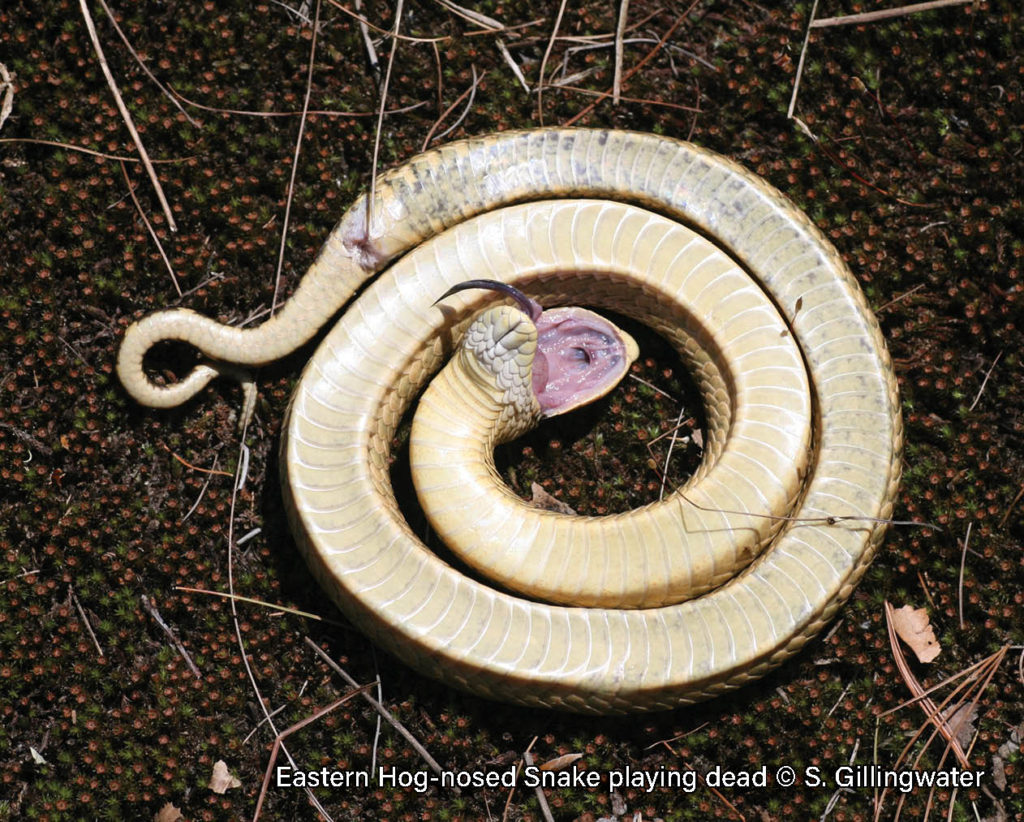
Picture of an Eastern Hog-nosed snake, a thick-bodied snake with a yellow belly. Snake is laying on its back with its mouth gaping open and tongue hanging out, playing dead.

Habitat

The Hog-nosed Snake prefers areas of open habitat near water with well-drained, loose or sandy soil. They are often associated with beaches and sand dunes, open grassland, as well as open woodlands, brushlands, and the forest edge. As prey specialists, they are found in areas of suitable habitat where toads are also present.
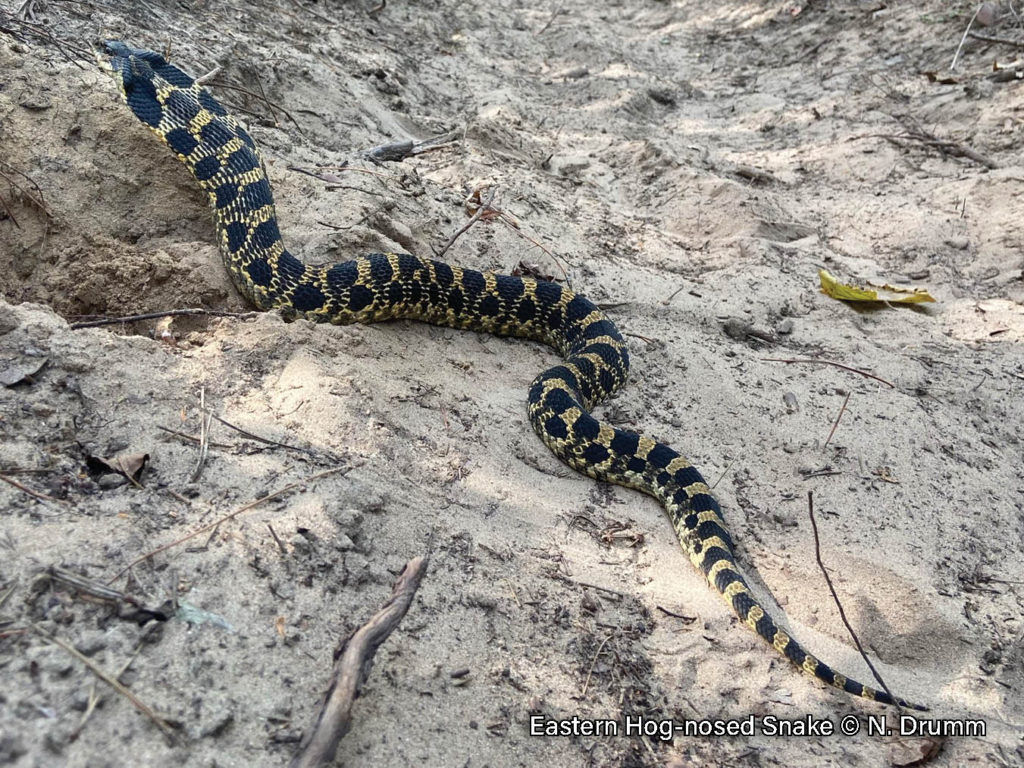
Picture of an Eastern Hog-nosed snake on sandy ground, a thick-bodied yellow snake with black blotches and an upturned snout. Snake has neck flared in a defensive display.

Distribution

The Hog-nosed Snake is found in North America across much of the eastern US, but in Canada, this species is restricted to two areas in Ontario: the Carolinian region in southern Ontario and the Great Lakes/St. Lawrence region south of the French River and Lake Nipissing and east of Georgian Bay in south-central Ontario. A full understanding of the species’ distribution in Ontario is not yet known, but research has shown that the Hog-nosed Snake has been extirpated from the regional municipalities of Halton, Peel, and York and Point Pelee National Park and Island. Certain areas of the province only have historic sightings available meaning they may have been lost from other areas as well.

Threats to the Eastern Hog-nosed Snake

Unfortunately, their aggressive, yet harmless defensive display often results in fatal interactions for Hog-nosed Snakes when encountered by humans. These interactions are one of several reasons for their declining populations. A primary threat is habitat loss, fragmentation and degradation, in particular, from the increased construction of roads and from shoreline development, which destroys their habitat and can lead to increased encounters between snakes and humans. Collection for the pet trade and this highly mobile snake’s vulnerability to road mortalities are also contributing to declining numbers.

Snakes at Risk

  • SAR in the Sydenham
  • Mussels
  • Fishes
  • Snakes
    • Eastern Foxsnake
    • Eastern Hog-nosed Snake
    • Eastern Milksnake
  • Turtles
Test Your ID Skills!
Check out our latest newsletter! Download

© 2026 · St. Clair Region Conservation Authority - The Sydenham River Watershed

  • Privacy

Press Enter to search · Esc to close