• Biodiversity
    • Why is Biodiversity Important?
    • Threats to Biodiversity
    • What are Species at Risk?
    • Recovery Planning
    • Environmental Monitoring
  • Species at Risk
    • Species at Risk
      • SAR in the Sydenham
      • Mussels
      • Fishes
      • Snakes
      • Turtles
    • Mussels
      • Eastern Pondmussel
      • Fawnsfoot
      • Kidneyshell
      • Lilliput
      • Mapleleaf
      • Northern Riffleshell
      • Purple Wartyback
      • Rainbow
      • Rayed Bean
      • Round Hickorynut
      • Round Pigtoe
      • Salamander Mussel
      • Snuffbox
      • Threehorn Wartyback
      • Wavy-rayed Lampmussel
    • Fishes
      • Blackstripe Topminnow
      • Eastern Sand Darter
      • Grass Pickerel
      • Northern Madtom
      • Northern Sunfish
      • Pugnose Minnow
      • Pugnose Shiner
      • River Darter
      • Silver Lamprey
      • Spotted Sucker
    • Snakes
      • Eastern Foxsnake
      • Eastern Hog-nosed Snake
      • Eastern Milksnake
    • Turtles
      • Blanding’s Turtle
      • Midland Painted Turtle
      • Northern Map Turtle
      • Snapping Turtle
      • Spiny Softshell
  • Stewardship
    • Healthy Watersheds Program
      • Sydenham Phosphorus Reduction Initiative
    • Managing Phosphorus
    • Phosphorus StoryMap
    • Reducing Pollution in Runoff
    • Best Management Practices Resources
  • Stories
  • Get Involved
    • What Can I Do?
    • Take the Stewardship Survey
    • Test Your ID Skills!
    • Report a Turtle Sighting
  • Resources
  • Contact Us
Sydenham River WatershedSydenham River Watershed
  • Biodiversity
    • Why is Biodiversity Important?
    • Threats to Biodiversity
    • What are Species at Risk?
    • Recovery Planning
    • Environmental Monitoring
  • Species at Risk
    • Species at Risk
      • SAR in the Sydenham
      • Mussels
      • Fishes
      • Snakes
      • Turtles
    • Mussels
      • Eastern Pondmussel
      • Fawnsfoot
      • Kidneyshell
      • Lilliput
      • Mapleleaf
      • Northern Riffleshell
      • Purple Wartyback
      • Rainbow
      • Rayed Bean
      • Round Hickorynut
      • Round Pigtoe
      • Salamander Mussel
      • Snuffbox
      • Threehorn Wartyback
      • Wavy-rayed Lampmussel
    • Fishes
      • Blackstripe Topminnow
      • Eastern Sand Darter
      • Grass Pickerel
      • Northern Madtom
      • Northern Sunfish
      • Pugnose Minnow
      • Pugnose Shiner
      • River Darter
      • Silver Lamprey
      • Spotted Sucker
    • Snakes
      • Eastern Foxsnake
      • Eastern Hog-nosed Snake
      • Eastern Milksnake
    • Turtles
      • Blanding’s Turtle
      • Midland Painted Turtle
      • Northern Map Turtle
      • Snapping Turtle
      • Spiny Softshell
  • Stewardship
    • Healthy Watersheds Program
      • Sydenham Phosphorus Reduction Initiative
    • Managing Phosphorus
    • Phosphorus StoryMap
    • Reducing Pollution in Runoff
    • Best Management Practices Resources
  • Stories
  • Get Involved
    • What Can I Do?
    • Take the Stewardship Survey
    • Test Your ID Skills!
    • Report a Turtle Sighting
  • Resources
  • Contact Us

Turtles

Home Species at Risk in the SydenhamTurtles

Turtles in the Sydenham

All 8 of Ontario’s native turtles are listed as species at risk. Major threats include habitat loss, road mortalities, and egg predation by racoons, skunks and coyotes. Less than 1 in 100 turtle eggs will hatch and make it to adulthood – saving the life of even one turtle can make a big difference to their population.

Cultural Significance

Turtles have deep cultural significance to First Nations people in Canada. In the Anishinaabe Creation story, North America was formed on the back of a turtle, which is why Turtle Island is the name for North America used by First Nation communities. The turtle shell also relates to the changing seasons – from the Turtle Island Conservation Programme Ways of Knowing Guide:

The Anishinaabe and Haudenosaunee people look at the Turtle’s back as a sort of calendar, with its pattern of thirteen large scutes standing for the thirteen moons of each year. It reminds them that all things are connected and we must try to live in balance.”

When are Turtles Active?

Like all reptiles, turtles are ectothermic, which means they cannot generate their own body heat, so they manage their temperature through behaviour like basking in the sun or sheltering from heat. They hibernate over the cold months and are typically active from April to October. A sunny day in spring is the best time to spot turtles soaking up the sun along the river. Female turtles spend a lot of time basking in the spring to help their eggs develop before starting to lay them in June.

What’s in a word?

  • ecto = outside or external
  • endo = inside or internal
  • therm = heat or temperature

Ectotherms, like reptiles and amphibians, rely on external temperatures to adjust their body temperatures.

Endotherms, like birds and mammals, regulate their body temperatures internally.

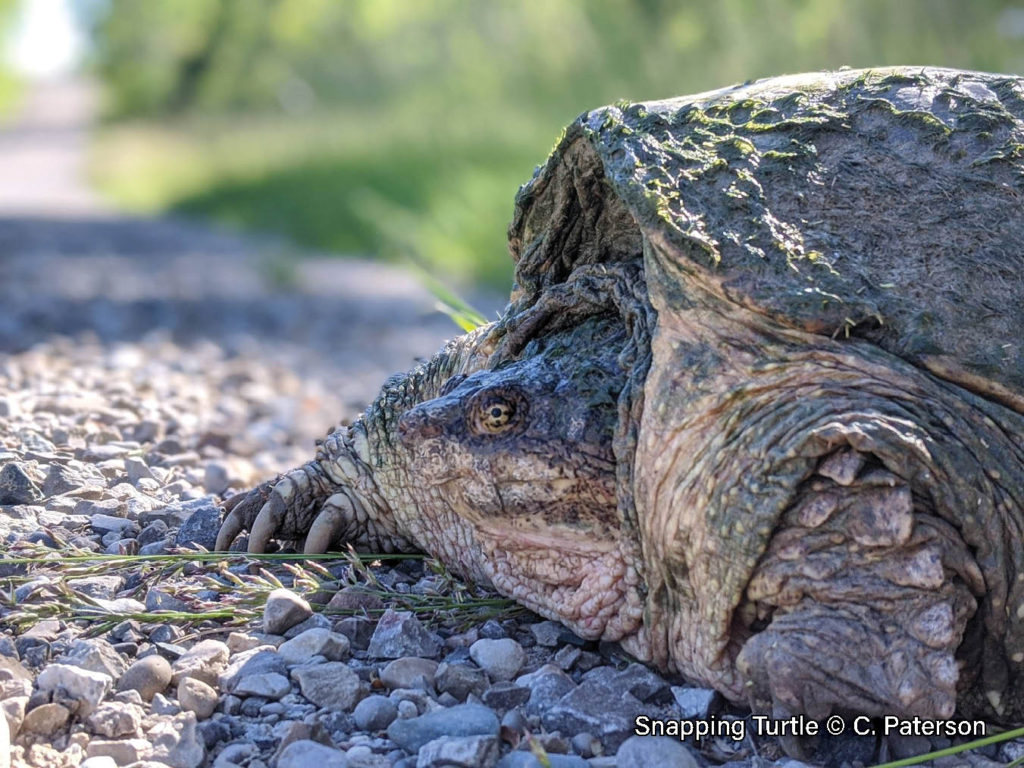
Close-up picture of a large adult Snapping Turtle with algae on its back crossing a gravel path. A turtle that has a broad, brown shell with three ridges, a serrated rear edge, and a large fleshy head and legs that cannot be fully retracted into its shell. It has a long tail with triangular projections down it.

Why did the turtle cross the road?
Male and female turtles can be seen travelling between April and October to forage, visit other habitats, breed or nest. June is the height of nesting season for Ontario’s turtles and is the time of year a lot of females are on the move. Be sure to keep an eye out for turtles when driving. If you spot a turtle on the road and it is safe to do so, slow down, pull over, and help the turtle cross in the direction they are travelling. Do not pick them up by their tail as this can injure their spine. Check out this video from the Toronto Zoo for tips on how to safely help a turtle cross the road.

How are Turtles Monitored?

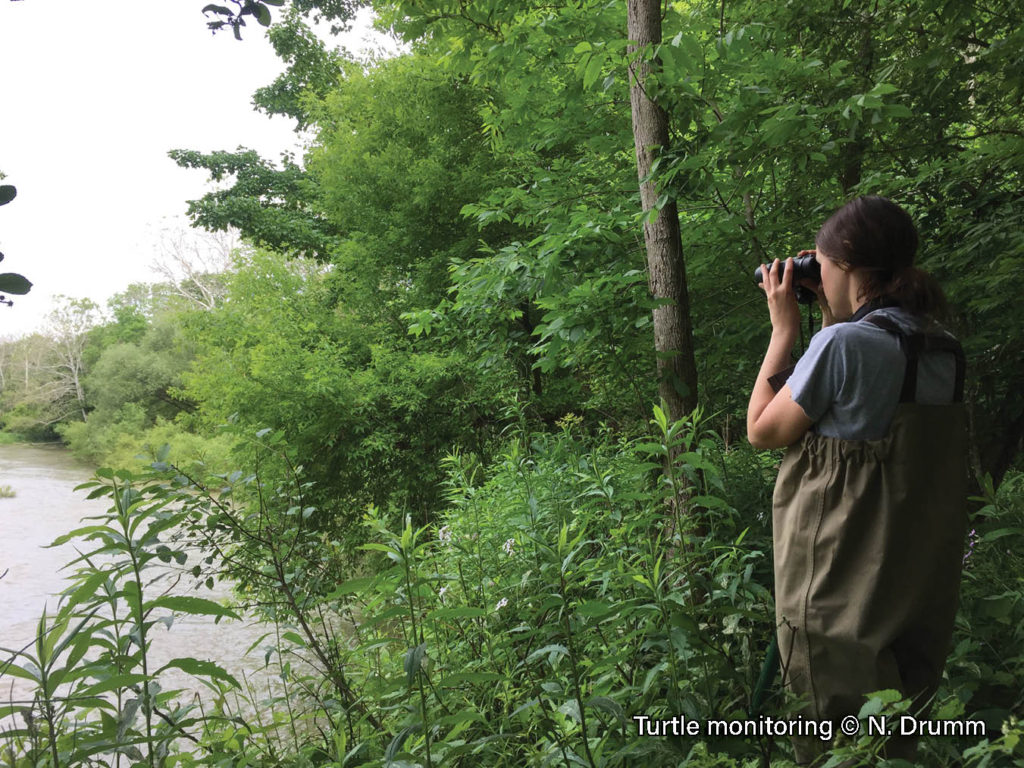
Turtle surveys are performed to document species as well as basking and nesting sites. Using binoculars, biologists travel as quietly as possible to catch sightings of turtles along the river. Contrary to popular belief, turtles can move pretty quickly especially when they are slipping off a basking log into the water.

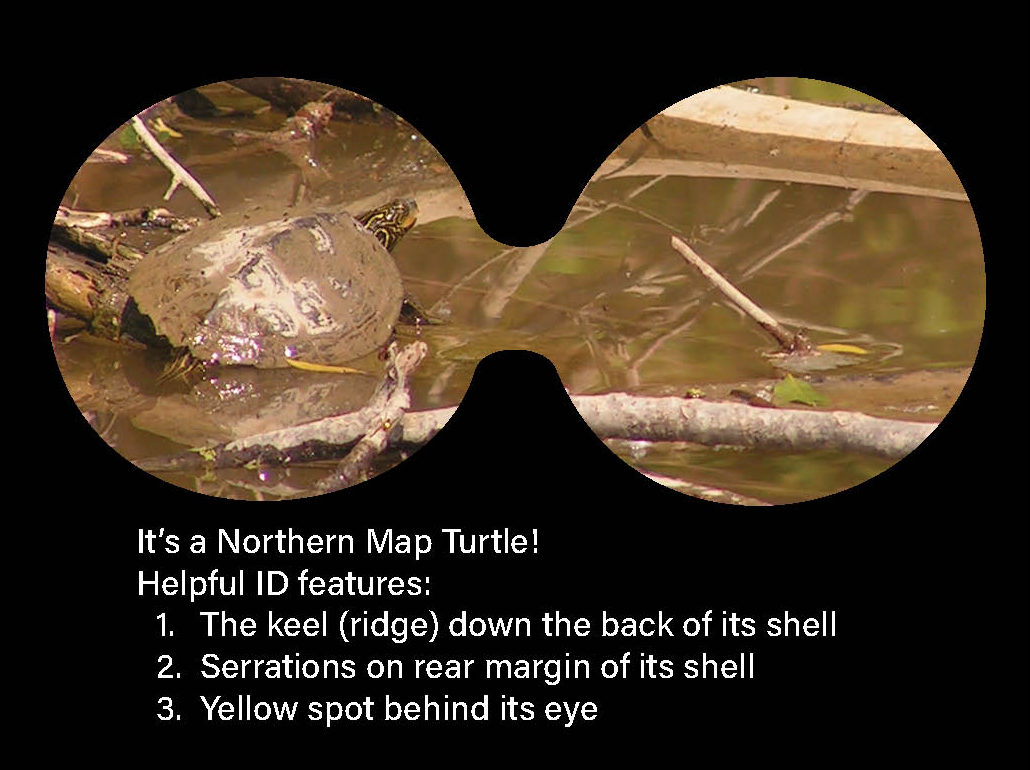
Surveyors train their eyes to spot the turtles and pick up the differences between species from far away. For example, a helpful ID feature to differentiate between Northern Map and Midland Painted Turtles from a distance is the Northern Map Turtle has a ridge that extends down the midline of its upper shell.

Picture of a biologist standing on a forested riverbank looking through binoculars monitoring for turtles.

Turtle species ID quiz

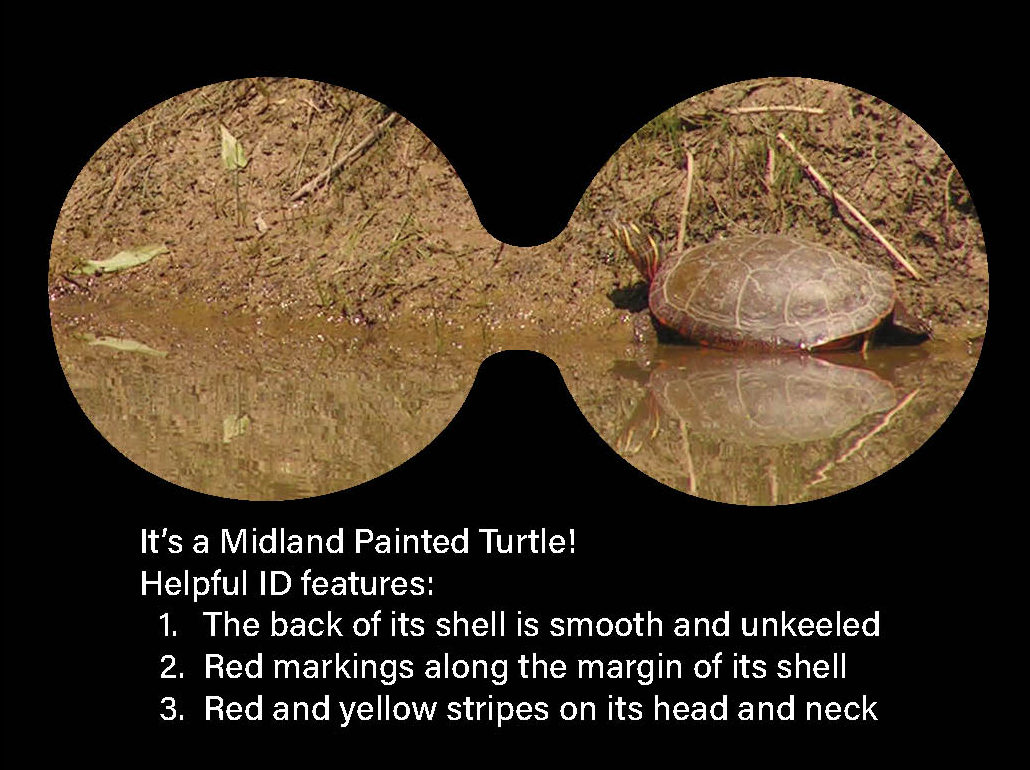
Try to determine these turtle species then hover over each image to reveal the answer and some helpful identifying features!

Picture of the turtle zoomed in as if looking through binoculars. Photo caption reads: "It’s a Northern Map Turtle! Helpful ID features: 1.The keel (ridge) down the back of its shell; 2. Serrations on rear margin of its shell; and 3. Yellow spot behind its eye"

Picture of the turtle zoomed in as if looking through binoculars. Photo caption reads: "It’s a Midland Painted Turtle! Helpful ID features: 1. The back of its shell is smooth and unkeeled; 2. Red markings along the margin of its shell; 3. Red and yellow stripes on its head and neck.”

Why are Turtles Monitored?

Survey data is recorded on the number of each species, habitat conditions, locations, and the weather. This information is valuable to learning more about the status of the local populations and identifying local threats that can be mitigated to give turtles a better chance at survival.

TURTLE GLOSSARY

Carapace: the upper shell of a turtle

Plastron: the lower shell of a turtle

Scutes: large scales that cover the bones of the shell

Thermoregulation: the process of maintaining core body temperature

Ectothermic: organisms that cannot generate their own body heat and rely on external temperatures, they regulate their internal temperature through behaviours such as basking or seeking shade

Habitat Fragmentation: the process where a continuous expanse of habitat is reduced to several smaller sections, often causing isolation

Habitat Degradation: processes that reduce habitat quality, this can occur through natural processes (drought, flooding) and through human activities (urbanization, agriculture)

Hibernaculum: (plural is hibernacula) a shelter occupied during the winter by a dormant animal, such as a turtle, snake, bat, or bear


Turtles at Risk

  • SAR in the Sydenham
  • Mussels
  • Fishes
  • Snakes
  • Turtles
    • Blanding’s Turtle
    • Midland Painted Turtle
    • Northern Map Turtle
    • Snapping Turtle
    • Spiny Softshell
Test Your ID Skills!
Report a Turtle Sighting
Check out our latest newsletter! Download

© 2026 · St. Clair Region Conservation Authority - The Sydenham River Watershed

  • Privacy

Press Enter to search · Esc to close