• Biodiversity
    • Why is Biodiversity Important?
    • Threats to Biodiversity
    • What are Species at Risk?
    • Recovery Planning
    • Environmental Monitoring
  • Species at Risk
    • Species at Risk
      • SAR in the Sydenham
      • Mussels
      • Fishes
      • Snakes
      • Turtles
    • Mussels
      • Eastern Pondmussel
      • Fawnsfoot
      • Kidneyshell
      • Lilliput
      • Mapleleaf
      • Northern Riffleshell
      • Purple Wartyback
      • Rainbow
      • Rayed Bean
      • Round Hickorynut
      • Round Pigtoe
      • Salamander Mussel
      • Snuffbox
      • Threehorn Wartyback
      • Wavy-rayed Lampmussel
    • Fishes
      • Blackstripe Topminnow
      • Eastern Sand Darter
      • Grass Pickerel
      • Northern Madtom
      • Northern Sunfish
      • Pugnose Minnow
      • Pugnose Shiner
      • River Darter
      • Silver Lamprey
      • Spotted Sucker
    • Snakes
      • Eastern Foxsnake
      • Eastern Hog-nosed Snake
      • Eastern Milksnake
    • Turtles
      • Blanding’s Turtle
      • Midland Painted Turtle
      • Northern Map Turtle
      • Snapping Turtle
      • Spiny Softshell
  • Stewardship
    • Healthy Watersheds Program
      • Sydenham Phosphorus Reduction Initiative
    • Managing Phosphorus
    • Phosphorus StoryMap
    • Reducing Pollution in Runoff
    • Best Management Practices Resources
  • Stories
  • Get Involved
    • What Can I Do?
    • Take the Stewardship Survey
    • Test Your ID Skills!
    • Report a Turtle Sighting
  • Resources
  • Contact Us
Sydenham River WatershedSydenham River Watershed
  • Biodiversity
    • Why is Biodiversity Important?
    • Threats to Biodiversity
    • What are Species at Risk?
    • Recovery Planning
    • Environmental Monitoring
  • Species at Risk
    • Species at Risk
      • SAR in the Sydenham
      • Mussels
      • Fishes
      • Snakes
      • Turtles
    • Mussels
      • Eastern Pondmussel
      • Fawnsfoot
      • Kidneyshell
      • Lilliput
      • Mapleleaf
      • Northern Riffleshell
      • Purple Wartyback
      • Rainbow
      • Rayed Bean
      • Round Hickorynut
      • Round Pigtoe
      • Salamander Mussel
      • Snuffbox
      • Threehorn Wartyback
      • Wavy-rayed Lampmussel
    • Fishes
      • Blackstripe Topminnow
      • Eastern Sand Darter
      • Grass Pickerel
      • Northern Madtom
      • Northern Sunfish
      • Pugnose Minnow
      • Pugnose Shiner
      • River Darter
      • Silver Lamprey
      • Spotted Sucker
    • Snakes
      • Eastern Foxsnake
      • Eastern Hog-nosed Snake
      • Eastern Milksnake
    • Turtles
      • Blanding’s Turtle
      • Midland Painted Turtle
      • Northern Map Turtle
      • Snapping Turtle
      • Spiny Softshell
  • Stewardship
    • Healthy Watersheds Program
      • Sydenham Phosphorus Reduction Initiative
    • Managing Phosphorus
    • Phosphorus StoryMap
    • Reducing Pollution in Runoff
    • Best Management Practices Resources
  • Stories
  • Get Involved
    • What Can I Do?
    • Take the Stewardship Survey
    • Test Your ID Skills!
    • Report a Turtle Sighting
  • Resources
  • Contact Us

Northern Riffleshell

Home Species at Risk in the SydenhamMusselsNorthern Riffleshell

Northern Riffleshell

Epioblasma rangiana

COSEWIC: Endangered
SARA: Endangered
SARO: Endangered

Species Description

The Northern Riffleshell is a small to medium sized mussel, measuring between 4 and 7cm. They have thick shells that are brightly coloured, ranging from yellowish-green to yellowish orange, and are decorated with thin, dark green rays. Riffleshells are sexually dimorphic meaning the males and females look different. The shells of males are indented with a deep furrow while the same area is distended in females to accommodate their gill marsupia, giving them a more oval appearance.
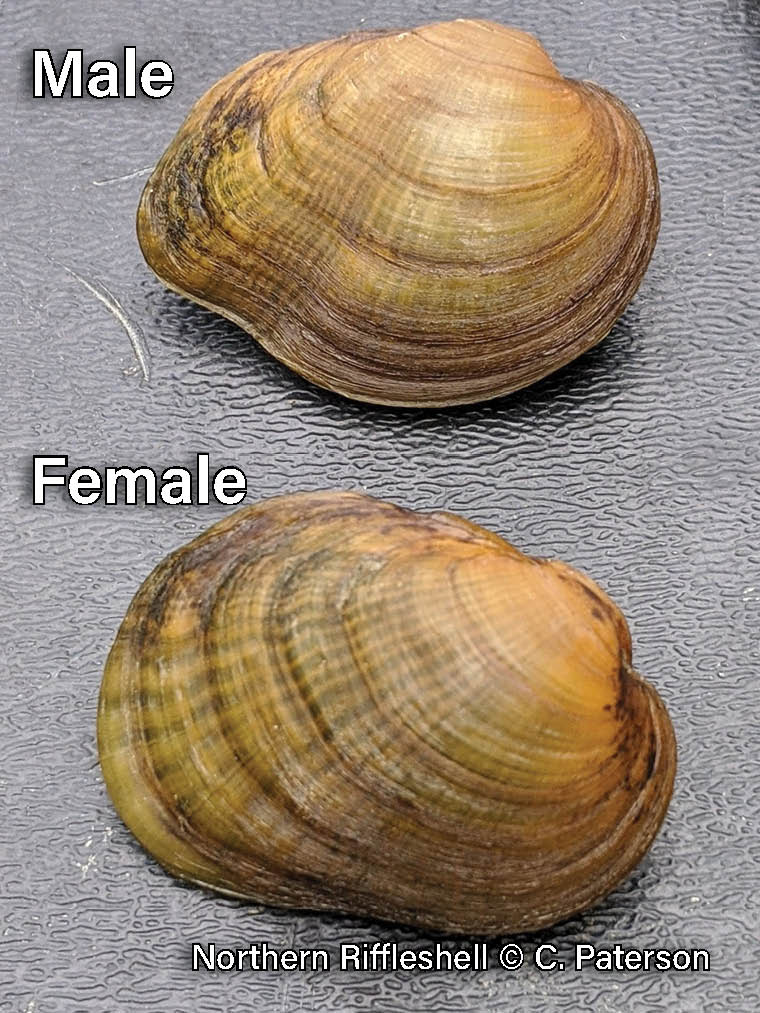
Picture of two Northern Riffleshell mussels, a small, yellowish-orange mussel with narrow green rays. The top mussel is a male, its shell has an indent. The bottom mussel is a female, in place of an indent, its shell extends creating a more oval shape.

Lifecycle: Catch and Release Fishing

Like the Snuffbox, another member of the genus Epioblasma, female Northern Riffleshells rely on host capture to ensure their glochidia attach to a host fish. Potential hosts include darters and sculpins. To lure in a host, female Northern Riffleshells open their shells to display their white mantle lining and patiently wait for a fish to investigate. When a curious fish looking for food approaches, the shell closes rapidly catching the unsuspecting fish by its head, or even its whole body if it is small. The female mussel inflates its mantle pads to subdue the fish. Then, the mussel releases its grip and gently cradles the dazed fish. As the fish gasps and inhales to recover, the mussel releases glochidia that attach to the fish’s gills. Once fully recovered, the fish swims away carrying the next generation of Northern Riffleshell to new areas of habitat in the river.

Underwater picture by M.C. Barnhart of the white mantle pads of a gaping female Northern Riffleshell that is partially buried in the riverbottom.

Underwater picture by M.C. Barnhart of a female Northern Riffleshell displaying its white mantle pads.

Distribution in the Sydenham

The Northern Riffleshell is globally imperilled. Once found throughout aquatic ecosystems in the Ohio River and Great Lakes drainage basins, the Northern Riffleshell has experienced a range reduction of more than 95% over the last 100 years. In Canada, the Northern Riffleshell is restricted to just two rivers, a 91km stretch of the Sydenham River and 44km reach of the Ausable River – together they are home to 25% of the global population. The East Sydenham River has the largest remaining reproducing population in Canada and is one of only four reproducing populations left in the world.

Within their limited distribution, Northern Riffleshells can be found in highly oxygenated riffles of rivers in areas with sandy or gravelly bottoms. In the Sydenham River, the Northern Riffleshell is concentrated in the middle and lower reaches of the East Branch. The Sydenham population appears to be relatively stable and is considered vital to the global survival of the species.

Picture of three Northern Riffleshell mussels, a small, yellowish-orange mussel with narrow green rays. The top left mussel is a male, its shell has an indent. The top right mussel is a female, in place of an indent, its shell extends creating a more oval shape. The bottom mussel is a sub-adult.
The Sydenham watershed contains critical habitat for the Northern Riffleshell, which means that habitat in the Sydenham is considered “necessary for the survival or recovery” of this Species at Risk.

Threats to the Northern Riffleshell

Like many freshwater mussels in Ontario, excessive pollution and siltation that enter rivers and streams through runoff from agricultural and urban developments, have negative impacts on Northern Riffleshells. Toxins can accumulate in the mussel flesh through filter feeding and excessive siltation can suffocate mussel beds. The introduction of invasive species like the Zebra and Quagga mussels combined with Round Goby can have devastating impacts. Dreissenids have caused declines in many native mussel species by competing for food sources and suffocating mussels by covering their shells. Round Goby can alter host fish communities by outcompeting native host species of the Northern Riffleshell, such as the Rainbow Darter, Logperch, Blackside Darter, and Mottled Sculpin.

Mussels at Risk

  • SAR in the Sydenham
  • Mussels
    • Eastern Pondmussel
    • Fawnsfoot
    • Kidneyshell
    • Lilliput
    • Mapleleaf
    • Northern Riffleshell
    • Purple Wartyback
    • Rainbow
    • Rayed Bean
    • Round Hickorynut
    • Round Pigtoe
    • Salamander Mussel
    • Snuffbox
    • Threehorn Wartyback
    • Wavy-rayed Lampmussel
  • Fishes
  • Snakes
  • Turtles
Test Your ID Skills!
Check out our latest newsletter! Download

© 2026 · St. Clair Region Conservation Authority - The Sydenham River Watershed

  • Privacy

Press Enter to search · Esc to close