Rainbow
Cambarunio iris (formerly: Villosa iris)


Cambarunio iris (formerly: Villosa iris)
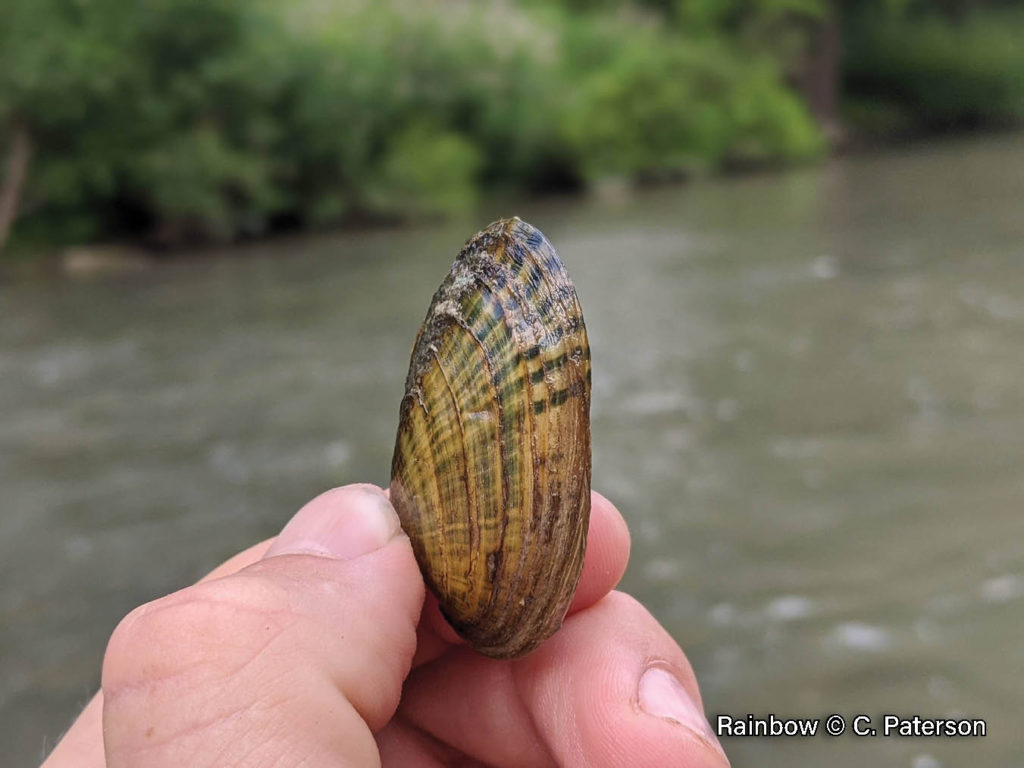
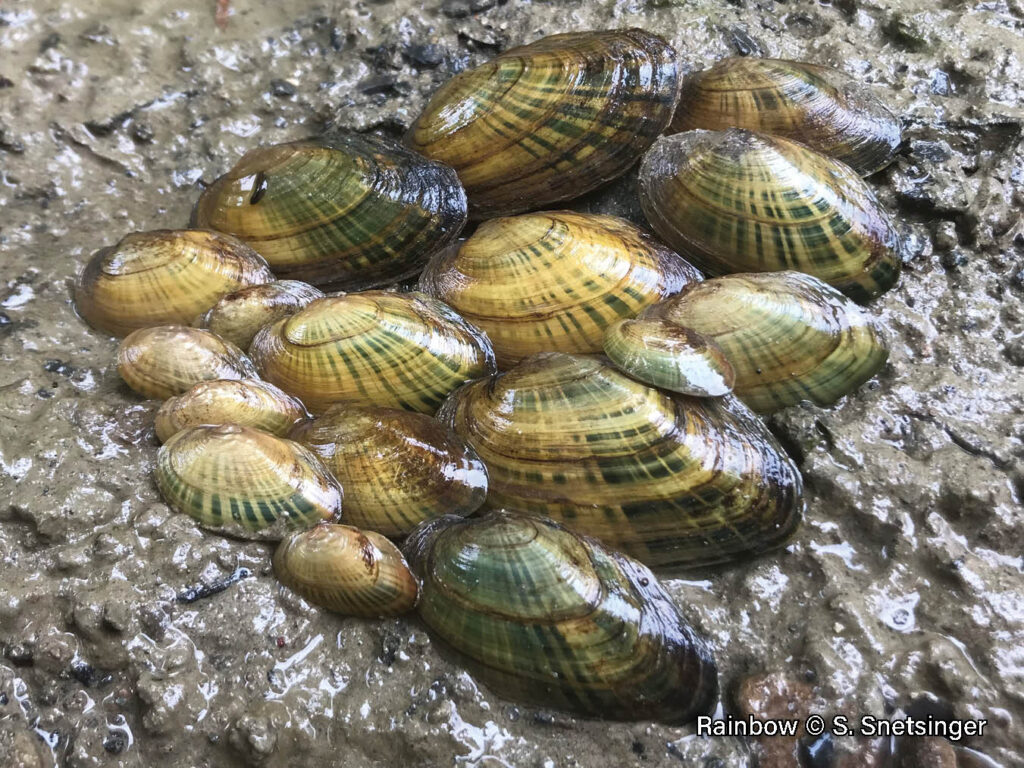
The Rainbow mussel is recognizable by its attractive periostracum, the skin-like outermost layer of the mussel shell, which has a yellow background and green rays. The pearly, iridescent inside of the shell, known as the nacre, is the reason for the species’ common name.
Generally, smaller animals tend to live shorter lives. Surprisingly, this little mussel, which grows on average to 5.5 cm, can live more than 40 years! Rainbows do not even start reproducing until the age of 5-9 years old!

Female Rainbow mussels use a novel technique to disperse their larvae. They have modified mantle tissue that looks like a crayfish and acts as a lure, designed to attract curious and hungry fish. When a fish gets close, the mussel billows out larvae. Larvae (called glochidia) attach to the gills of the fish and encyst.
In Ontario, host fish species for the Rainbow mussel include Striped Shiner, Smallmouth Bass, Largemouth Bass, Green Sunfish, Greenside Darter, Rainbow Darter, and Yellow Perch. Developing larvae gain nourishment from the fish host. By attaching to fish as aquatic hitchhikers, the mussel larvae are able to disperse upstream and further beyond the home range of the female parent.

Rainbow Mussel Lifecycle: Male mussel (1) releases sperm (2) that are then sucked up by the female via the incurrent siphon. (3) After fertilization, eggs develop in marsupial pouches into a larval stage called glochidia. The female mussel’s modified mantle tissue resembles a crayfish. A Greenside Darter (4) is attracted by the female’s crayfish lure. The female mussel releases glochidia, which are 0.35 mm long (5). Glochidia are like little “pac man” that snap shut when triggered, attaching to fish gills (6 – magnified view). Parasitic glochidia become encysted on the gills of the host fish. The glochidia are parasitic because they absorb nutrients and oxygen from the host fish. (7) Once the receiving adequate nourishment from the fish, juvenile mussels drop off the gills (8) and bury themselves in the river sediment. (9) Young mussels will become sexually mature at 5-9 years old.
Astonishingly, the Rainbow mussel has evolved a mantle flap modified to look like a crayfish. They use this lure to attract host fish for their glochidia.
Watch this Rainbow mussel “dance.” The mussel rocks back and forth and wriggles its lure to create a convincing impression of a crayfish in order to attract a host fish!
Video: A Rainbow Mussel displaying its lure and muscular foot (video by SWGMussels)
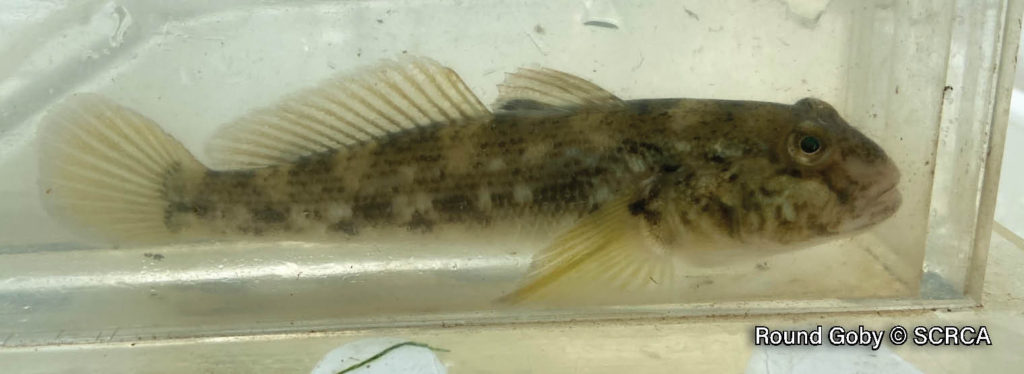
A Larval Sink: The range expansion of Round Goby in the Sydenham River is a concern because they can impact remaining mussel populations by disrupting their reproductive cycle. For example, the Rainbow mussel may release their larvae for the Round Goby instead of the appropriate host fishes. Since the two species have not co-evolved, the nourishment and dispersal functions could be lost. Compounding the problem, the presence of Round Goby, which competes for resources, is likely to diminish abundance of native fish hosts.
Of the roughly 5 million rainbow mussels occurring in Canada, all of which are found in southern Ontario, about 17,000 to 18,000 live in the Sydenham River. In the Sydenham River, they inhabit the East Branch and a tributary of the North Branch, Bear Creek, south of Warwick.
Freshwater mussels are susceptible to anthropogenic disturbance making them excellent indicator species or “bioindicators.” They are colloquially referred to as the “aquatic canaries in the coal mine” or the “livers of the rivers” because of their sensitivity to environmental disturbance and pollution and their filtering capacity.
Rainbow mussels prefer clear, fast flowing, and rocky headwaters. They are particularly susceptible to chemicals, and are absent or found in lower densities in watercourse reaches with high levels of contaminants. Studies have shown that the rainbow mussel is particularly sensitive to copper and ammonia. Anthropogenic sources of copper can include fungicidal treatments, liquid manure (mainly from pigs), sewage sludge, biosolids, and atmospheric deposition. In the environment, the main source of ammonia is manures, slurries, and fertilizer application. Landfill sites, sewage works, composting of organic materials, combustion, industry and wild mammals and birds are also contributing sources of ammonia.
Knowing what we do about their long lifespan, biologists can conclude that presence of mature Rainbow mussels, could indicate the water has been relatively free from the pollutants mentioned above for over 40 years! On the other hand, mussel die-offs can signal pollution or other threats.

According to the 2015 COSEWIC assessment:
This small mussel is widely distributed in southern Ontario. Surveys since the previous assessment in 2006 have found large numbers of individuals in previously unknown localities, especially at headwaters of larger rivers. There is strong evidence of recent recruitment in six of the seven subpopulations examined. Although it has been lost from Lake Erie and the Detroit and Niagara Rivers, it was apparently never common in these waters. Two subpopulations (Ausable River and Lake St. Clair) have low abundance and are showing signs of continued decline. Ongoing threats to some subpopulations include invasive species (dreissenid mussels and Round Goby) and pollution (household sewage and urban wastewater as well as agricultural effluents). The species may become Threatened if threats are not effectively managed or mitigated.”
© 2026 · St. Clair Region Conservation Authority - The Sydenham River Watershed
Press Enter to searchEsc to close