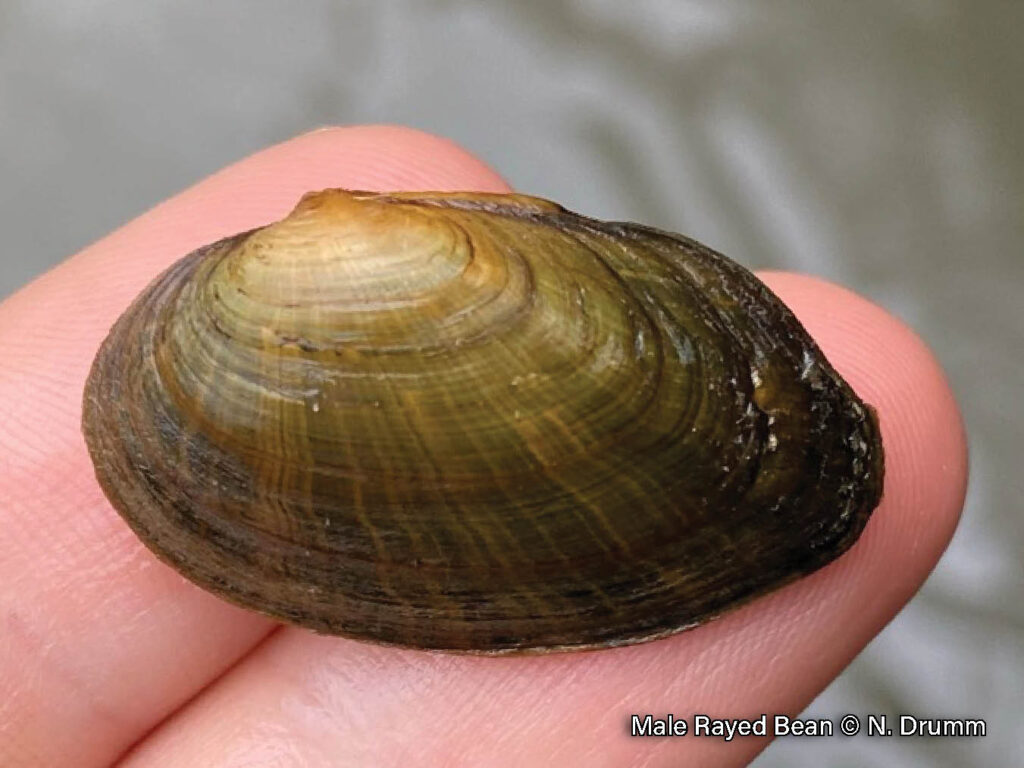
Rayed Bean
Paetulunio fabalis (formerly: Villosa fabalis)


Paetulunio fabalis (formerly: Villosa fabalis)
The Rayed Bean mussel is a small animal, measuring a maximum length of 4cm at maturity, but on average only 2cm. Their shell is elliptical and very thick. They are greenish brown and covered with dark green rays. They are the only unionids known to retain byssal threads (spiderweb-like protein filament) into adulthood, which they use to loosely anchor to rocks and other hard surfaces.
In part because of the rarity of the Rayed Bean, its lifecycle is mostly unknown. The age of sexual maturity is approximately to 6-12 years of age, based on other freshwater mussels.
Like other unionids, Rayed Beans rely on a host for their larvae, known as glochidia. Host fishes for this mussel include Rainbow Darter, Greenside Darter, Mottled Sculpin, and Largemouth Bass. Greenside Darters are believed to be an important host for Rayed Beans in the Sydenham River.
Aging Rayed Beans
In the summer of 2020, SCRCA biologists collected over 200 Rayed Bean valves (half shells) that were sent to Fisheries and Oceans Canada for aging. Annual and sub-annual growth rings formed on the valve can indicate the age of the mussel. The size of growth rings are also a window to past environmental conditions, since factors such as pollutants and temperature influence the formation of rings.

Fisheries and Oceans Canada has aged other mussel shells from the Sydenham River. Their analysis of 53 Purple Wartyback (Cyclonaias tuberculata) valves from Southwestern Ontario revealed that the species lives up to 65 years old! We will have to wait to see what the Rayed Bean valves collected from the Sydenham River reveal. Stay tuned for updates.
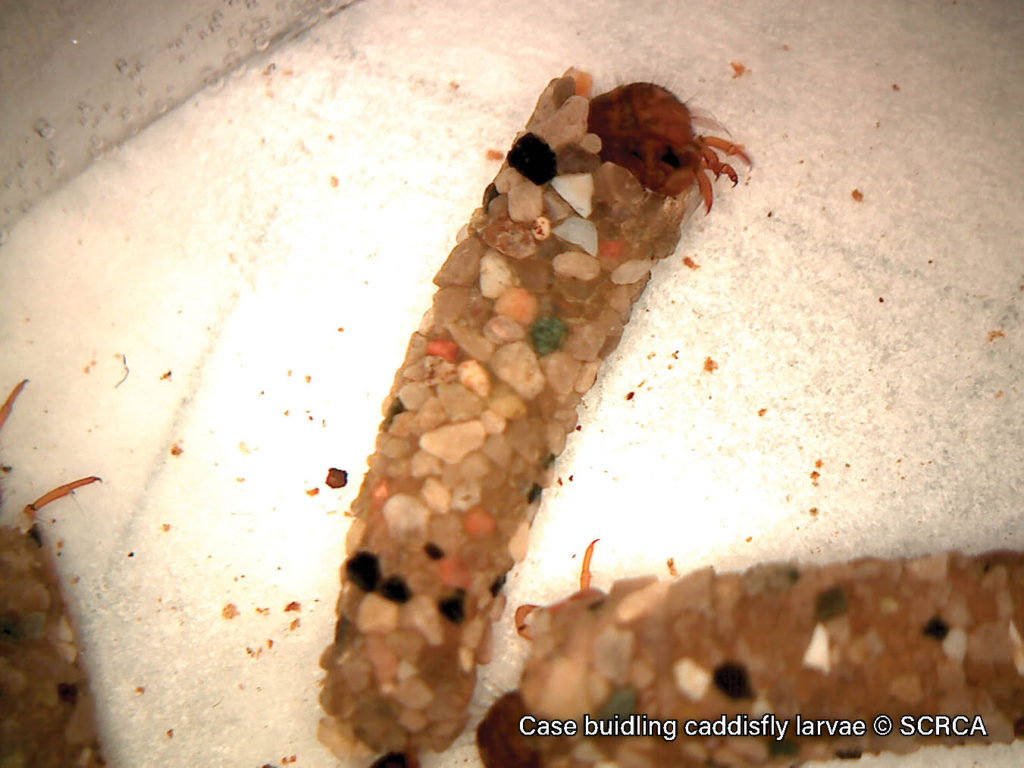
Rayed Beans produce byssal threads, which are spider web-like strings made from protein and used to attach the mussels to gravel, rocks and other substrate (sometimes even other mussels). Another river-bottom animal, the case maker caddisfly larva uses a similar protein to make protective cases of pebbles and sand. In a healthy colony, research has found 12 million caddisfly cases in a 5km stretch of river, which can secure 240 million grains/8 tonnes of substrate! The roots of aquatic plants also helps to hold substrate in place further stabilizing the river bottom. Together these plants and animals help to stitch the river bottom together, making it less susceptible to erosion.

The Rayed Bean is extremely rare throughout its range. It was once known to exist in 115 rivers and lakes, it is now known to inhabit only 31 river systems and one lake in Canada and the United States. These figures represent a more the 70% decline in range. Less than 20% of the global population resides in Canada. The Canadian population of Rayed Bean is limited to the East Branch of the Sydenham River and about a 4km stretch of the Thames River.
According to the 2010 COSEWIC assessment report:
This freshwater mussel is one of the smallest in Canada. It is found in two rivers in southern Ontario; more than 99% of the estimated total population is found in the Sydenham River. The original COSEWIC assessment (2000) concluded that it had been extirpated from most of its Canadian range and was confined to one river but a new, albeit small, population was discovered in 2004 in the North Thames River. Thirteen live individuals were found between 2004 and 2008 in this river. The main limiting factor is the availability of shallow, silt–free riffle habitat. Both riverine populations are in areas of intense agriculture and urban development, subject to siltation and pollution. Invasive Zebra Mussels have rendered much of the historic habitat unsuitable and pose a continuing threat to one of the last remaining populations.”
Why so many (empty) shells?
Something SCRCA biologists are curious about is: “Why did we find so many fresh looking Rayed Bean valves, while studying SAR mussel abundances in the East Sydenham River between Shiloh Line and Courtright Line in summer 2020?”
There are several possible conclusions for this interesting observation: maybe the flow pattern of the Sydenham River in this stretch favours deposition of Rayed Bean valves? Maybe this species has a shorter generation time than other unionids? Maybe there is a natural cycle of die-offs? A more alarming conclusion one might draw is that Rayed Beans are declining in the Sydenham River, as has happened elsewhere in the world.
Much more research is required to answer this question definitively. SCRCA biologists will be studying another 2.5km stretch of the Sydenham River in 2021. Hopefully, this additional study will shed more light on our questions.

The floating freshwater mussel field lab, affectionately known by the crew as “Pyganodon.” Its namesake is the genus that includes Giant Floater (Pyganodon grandis) a mussel species found in the Sydenham.
© 2026 · St. Clair Region Conservation Authority - The Sydenham River Watershed