

Bringing the Classroom to Life with the University of Guelph
February 2023 | SCRCA Biology Team
Diving beyond textbooks
If nature is our greatest teacher, then the Sydenham River offers a masterclass in Evolution 101.
The Sydenham River supports the greatest diversity of native freshwater mussel species of any watershed in Canada – 34 of the 54 species of freshwater mussels found in Canada occur in the Sydenham.
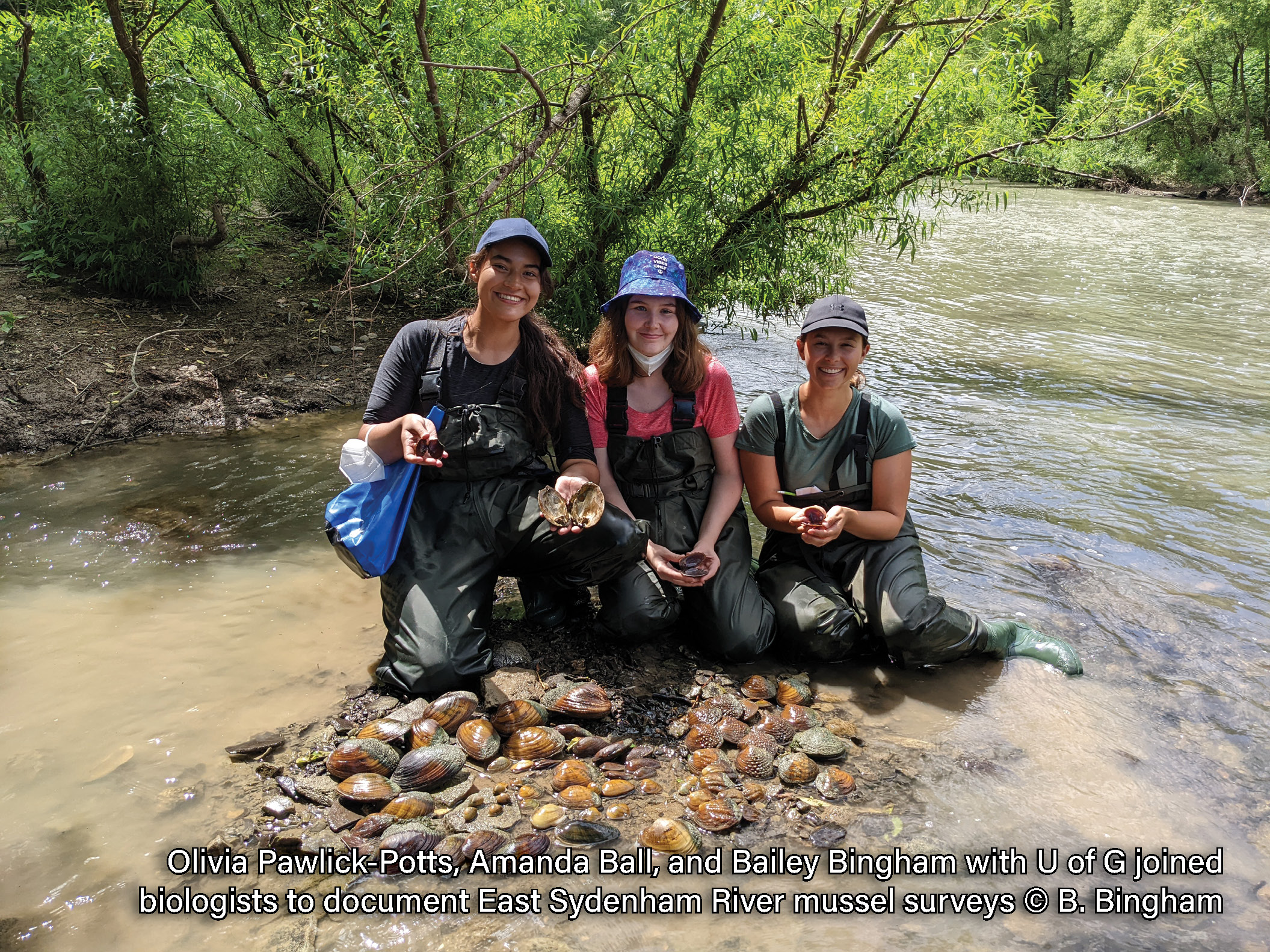
This wealth of biodiversity concentrated in a nearby river piqued the interest of University of Guelph Integrative Biology Instructor, Bailey Bingham. Bailey helps teach the university’s first year biology course “Discovering Biodiversity” (BIOL1070) and the Sydenham River seemed like the perfect place to explore real-life examples in southern Ontario.
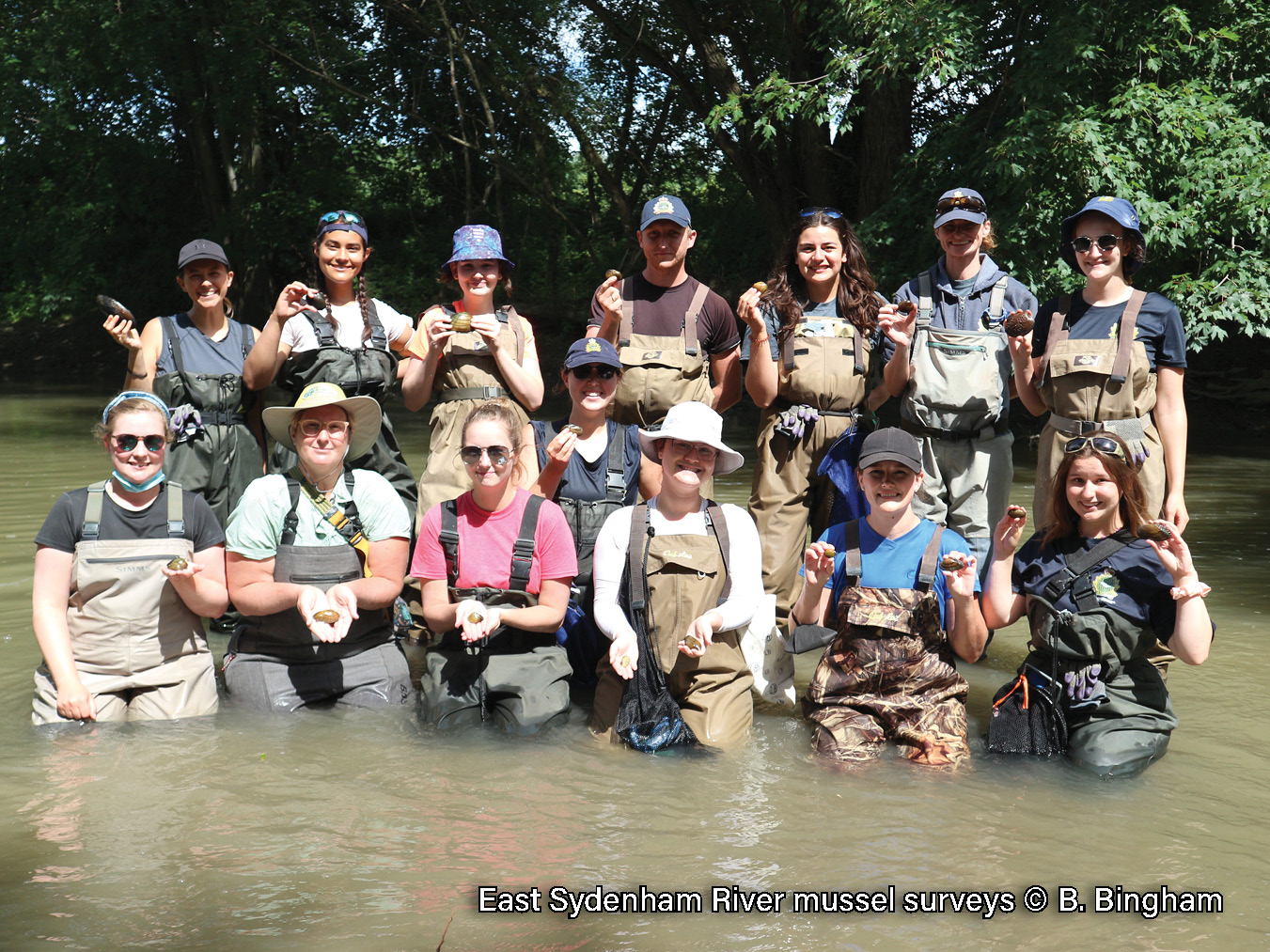
During the 2022 field season, Bailey along with undergraduate summer research assistants, Olivia Pawlick-Potts and Amanda Ball, joined biologists from Fisheries and Oceans Canada, the St. Clair Region Conservation Authority, and University of Windsor Healthy Headwaters Lab who were completing mussel surveys in the East Sydenham River (please note that these surveys were led by trained biologists with the necessary permits to handle these animals).
Mussels as a study organism
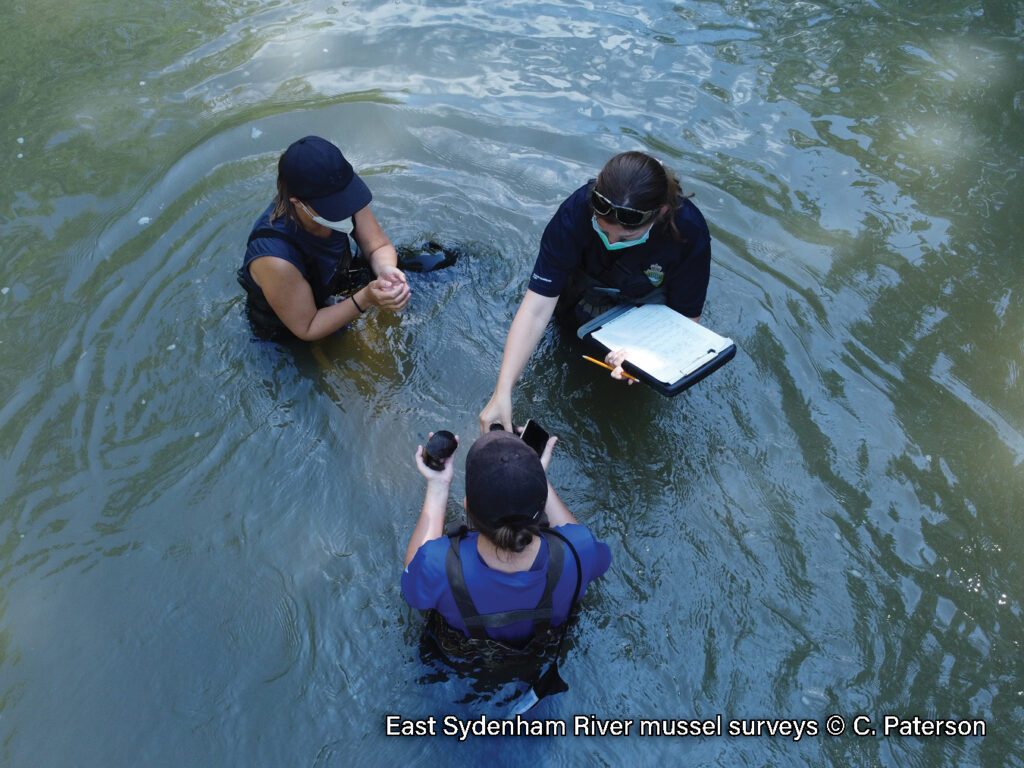
The team from the University of Guelph documented the field work methods, capturing footage of the field crews completing mussel surveys and taking opportunities to interview biologists from the river.
The course content they developed from the field season showcases native freshwater mussels as study organisms to teach different evolutionary concepts. For example, the fascinating and complex lifecycles of native freshwater mussels – which require a host fish – are examples of adaptations that have evolved through the process of natural selection.
The work that Bailey’s team undertook means that the amazing diversity of the Sydenham River will be shared with nearly 1,600 students annually!
I think the work we did to incorporate the mussel work along the Sydenham River into our course content will be really engaging for our students. It will show students the uniqueness of and diversity within a habitat in our own backyard of southern Ontario. It will give students context for why we should care about mussels, which are often seen as boring or unimportant. By increasing their level of knowledge, it may encourage them to take responsibility for how to maintain aquatic habitats around them and avoid actions that could damage them.”
— Amanda Ball, University of Guelph Undergraduate Summer Research Assistant
Here is one of the videos put together by Bailey and her team. In it Kelly McNichols-O’Rourke, Aquatic Science Biologist with Fisheries and Oceans Canada, discusses mussel diversity in the Sydenham River:
Performing mussel surveys
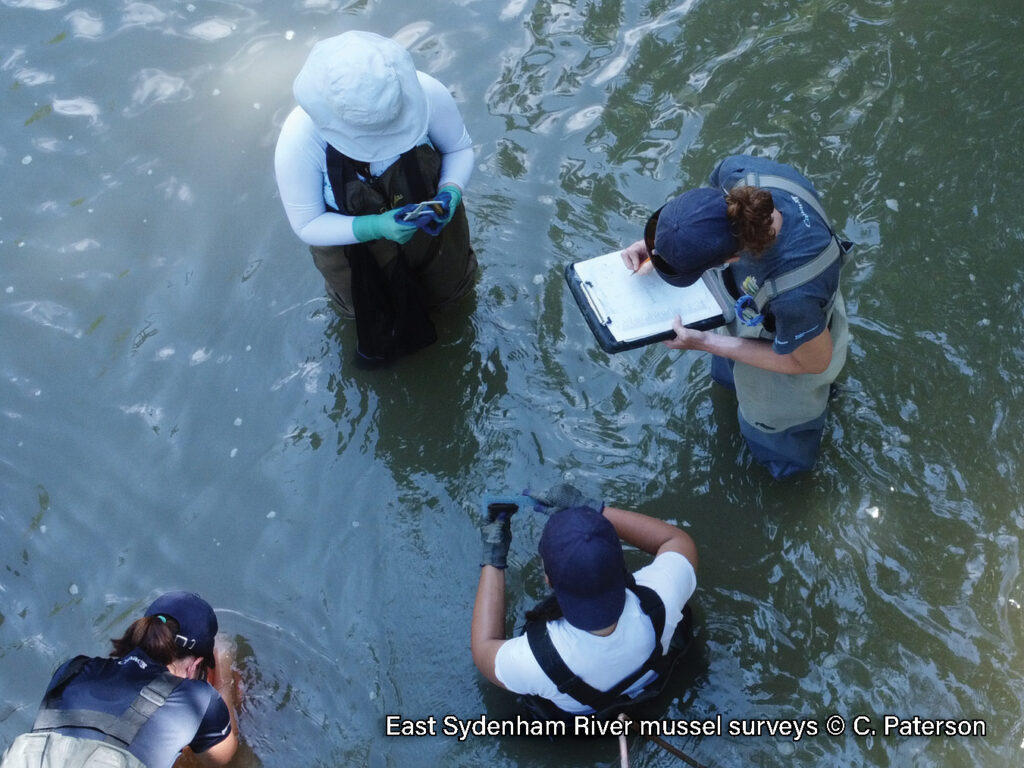
The crew from the University of Guelph also gained first-hand experience performing freshwater mussel surveys – they learned about mussel survey methods and which physical traits to look for to distinguish the different species.
For these surveys, field crew members would carefully excavate the top layer of one-square-meter sections of the riverbed to see how many mussels (abundance) and what species (diversity) were present. The habitat can be highly variable even across a small section of river, which results in different abundances and diversity of species.
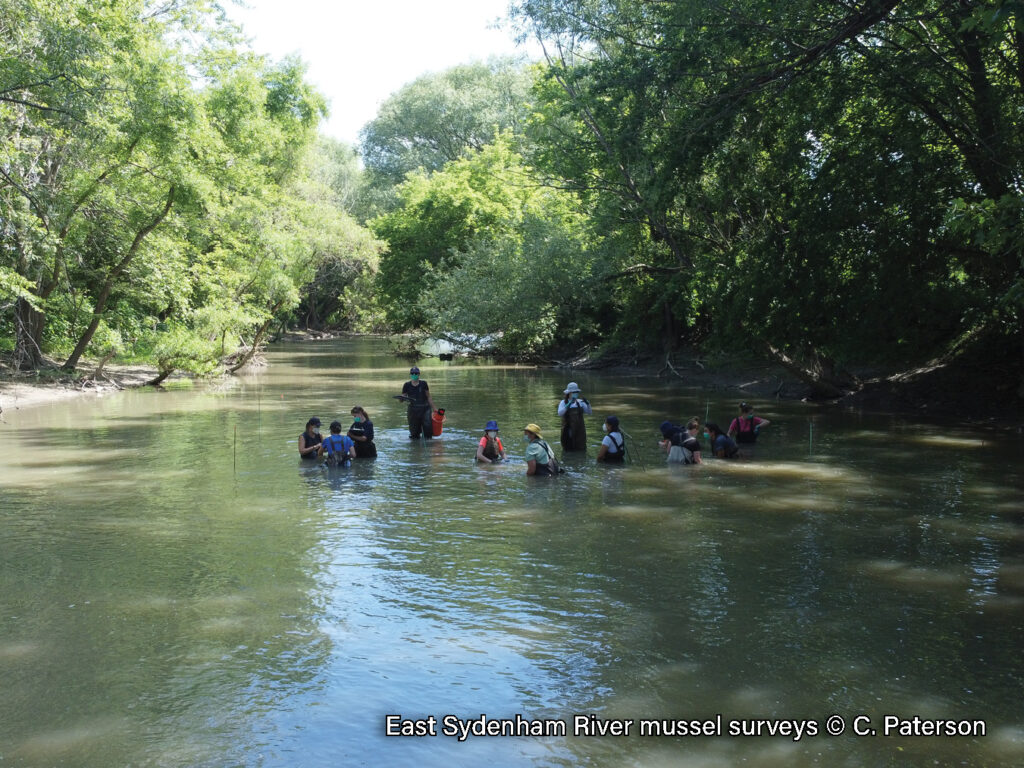
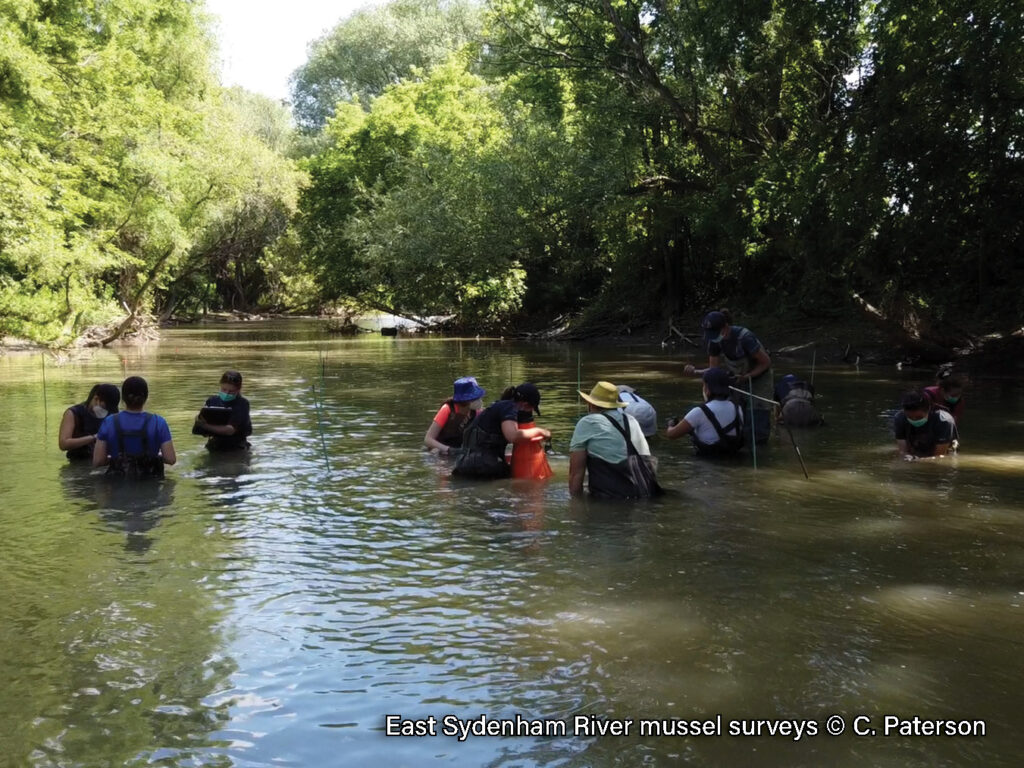
Soon after sampling began we began to observe differences in the diversity of native mussels that were found at different sites. On our first day of sampling we found 21 species of mussel! On the second day, at a different site, we found only 9 species. In one particular diverse area, we found 8 species and over 30 individuals in just 1 meter squared!”
— Bailey Bingham, University of Guelph Integrative Biology Instructor
Opening eyes to the world of mussels
The group also discussed issues that are threatening the survival of these animals. A staggering number – 14 of the 34 species – of mussels found in the Sydenham River watershed are Species at Risk. Two major threats that they face are pollution and sediment, which are washed off the land by stormwater runoff and end up in the water, where, sadly they are toxic to or smother these filter feeders.
The decline in the health of mussel populations is an early warning sign that water quality is in trouble, which has far reaching impacts. This is why it is so important to increase awareness and appreciation for these cool creatures – not only for their inherent value as a part of nature but also the ecosystem services as they provide like cleaning the water and stabilizing the streambed.
My time doing fieldwork in the Sydenham River was incredible and eye opening experience. While I have always been enthusiastic about wildlife and cool critters in general, I was not expecting the wealth of biodiversity found within the mussels of the Sydenham river substrate. At first glance, spotting differences between species proved difficult. The key features distinguishing these species can be rather obvious – such as the complex lures demonstrated in some – or rather minute such as the subtle shell fluting found in others. It is my opinion that biodiversity such as that found within mussels should not only be deeply appreciated for their hidden beauty, but for their inherent ecological significance as well. The bounty of life found within the Sydenham River is both deeply intriguing and a marvel to behold. As such, I would encourage others to work to conserve this precious piece of Canadian wildlife, both for the health of the ecology of Southern Ontario as well as for respect for the inherent beauty of nature that encircles us.”
— Olivia Pawlick-Potts, University of Guelph Undergraduate Summer Research Assistant
Help Protect the Sydenham
The Sydenham River watershed is home to many fascinating and globally rare creatures. The river is biologically important and considered a Freshwater Key Biodiversity Area by the IUCN as it is essential in supporting the continued survival of certain species in the wild.
Learn more about the mussels of the Sydenham River and ways you can help to protect them!