
Grass Carp – Invasive Species on the Doorstep of the Great Lakes
November 2023 | Asian Carp Program, Fisheries and Oceans Canada
Aquatic Invasive Species (AIS) are one of the chief threats to the health of the Great Lakes! These are aquatic animals and plants that are from somewhere else and that can harm other animals, plants, the environment, or people. AIS are often better at finding food and habitat compared to native species, making AIS fierce competitors as they take what our native animals and plants need to survive and thrive. Non-native aquatic species are being found in Canada with increasing frequency, and the Great Lakes basin is the AIS hotspot in Canada with over 180 non-native species in our waters. AIS can be introduced to new environments in many ways, including through live trade, recreational boating, illegal human mediated movement, commercial shipping and more.
Among the top aquatic invaders being monitored for their potential arrival into the Canadian waters of the Great Lakes are four invasive fish species – Grass Carp, Black Carp, Bighead Carp and Silver Carp – native to major river systems in China and Russia, a range similar enough to North American climate system that these four species could survive and thrive here. These carps were introduced to the Southern United States (U.S.) in the 1960s and 1970s for use as a biological control method in aquaculture facilities because of their specific diets. Flooding allowed at least three of the four species (Bighead, Silver and Black carps) to escape these facilities and rapidly make their way into the Mississippi River Basin, where they have dramatically increased their population. The spread of Grass Carp has largely been the result of using the fish as a method to control aquatic plants. Finding themselves in an ideal aquatic habitat free of any natural predators, all four species have been able to spread throughout U.S. river systems towards the Great Lakes, with Grass Carp having the closest invasion front to the Canadian Great Lakes.
Timelapse of Grass Carp Invasion in U.S. and Canada from 1968-2020 (courtesy of Fisheries and Oceans Canada)
None of the four carps species have established populations in Canadian waters – there have been no captures or recorded sightings of Silver Carp, Bighead Carp or Black Carp in Canadian waters since Fisheries and Oceans Canada’s Asian Carp Program began in 2012-2013. However, very low numbers of Grass Carp have been captured in Canadian waters of Lakes Erie, Ontario and Huron. Even though there is confirmed spawning on the U.S. side of Lake Erie, there is no evidence Grass Carp are spawning, or are established in Canadian waters. For an establishment to occur we would need to see evidence of Grass Carp spawning in Canadian waters and for their offspring to have survived here over more than one winter. Proof of an establishment would take the form of consecutive years of capturing newly hatched Grass Carp, which we know were born in Canadian waters.
Of the four species, Grass Carp represents the most immediate threat to the Canadian waters of the Great Lakes since they are spawning in rivers on the U.S. side of Lake Erie. They can grow to be 1.4 meters long and they can gain one kilogram per month, reaching up to 45 kilograms – they quickly outgrow the mouth size of native predatory fishes and therefore they would have few natural predators in Canadian waters. Grass Carp have voracious appetites and can eat up to 40% of their body weight in aquatic plants every day. They are also prolific breeders with females capable of producing over a million eggs in a spawning season, and in turn thousands of offspring each year. Due to their eating and breeding habits, if left unchecked, only 20 Grass Carp (10 males and 10 females) could take over and dominate the Great Lakes.
By eating such huge quantities of aquatic plant biomass, Grass Carp can significantly alter the composition of habitat by reducing shelter from predators and spawning areas for native fishes. Also, because Grass Carp can only digest about half of the aquatic plant material that they consume each day, the remaining material is expelled into the water, enriching it with nutrients which promotes algal blooms that negatively impact water quality and pose a threat to human health and safety. Algae blooms can become toxic to swimmers who come into contact with it, as well as it can pose a great threat to dogs and other pets that come in contact with or drink the water – making it so that the public cannot enjoy lakes and rivers anymore. Grass Carp would have devastating impacts on the fishing industry and on the green spaces adjacent to these waterways by destroying and degrading wetlands, which are home to a multitude of bird, mammal, reptile and amphibian species.
To help you visualize and understand the effects that Grass Carp have on ecosystems – the graphic below represents a healthy and balanced ecosystem – there is a diverse fish community, water quality that appears good and clear, there are multiple species of aquatic plants, and birds and amphibians using the habitats. You can see that as Grass Carp begin to invade the ecosystem, it starts to become more and more degraded – showing the negative impacts that Grass Carp can have on ecosystems.
Impacts of Invasive Grass Carp on an Ecosystem (courtesy of Fisheries and Oceans Canada)
The Great Lakes ecosystems contribute $13.8 billion to the Canadian economy every year through commercial, recreational and subsistence fishing, water use, water based hunting, oil and gas development, commercial navigation, recreational boating, waterfront use and wildlife viewing. These industries and activities depend heavily on the health and ecological state of the Great Lakes. The ecological impacts of Grass Carp have the potential to result in billions of dollars in losses to the Canadian economy. The potential impacts on Indigenous communities in the Great Lakes basin could include increased challenges to stewardship, as well as decreased commercial and subsistence fishing, food or medicine for harvesting, and opportunities for ecotourism and guiding activities.
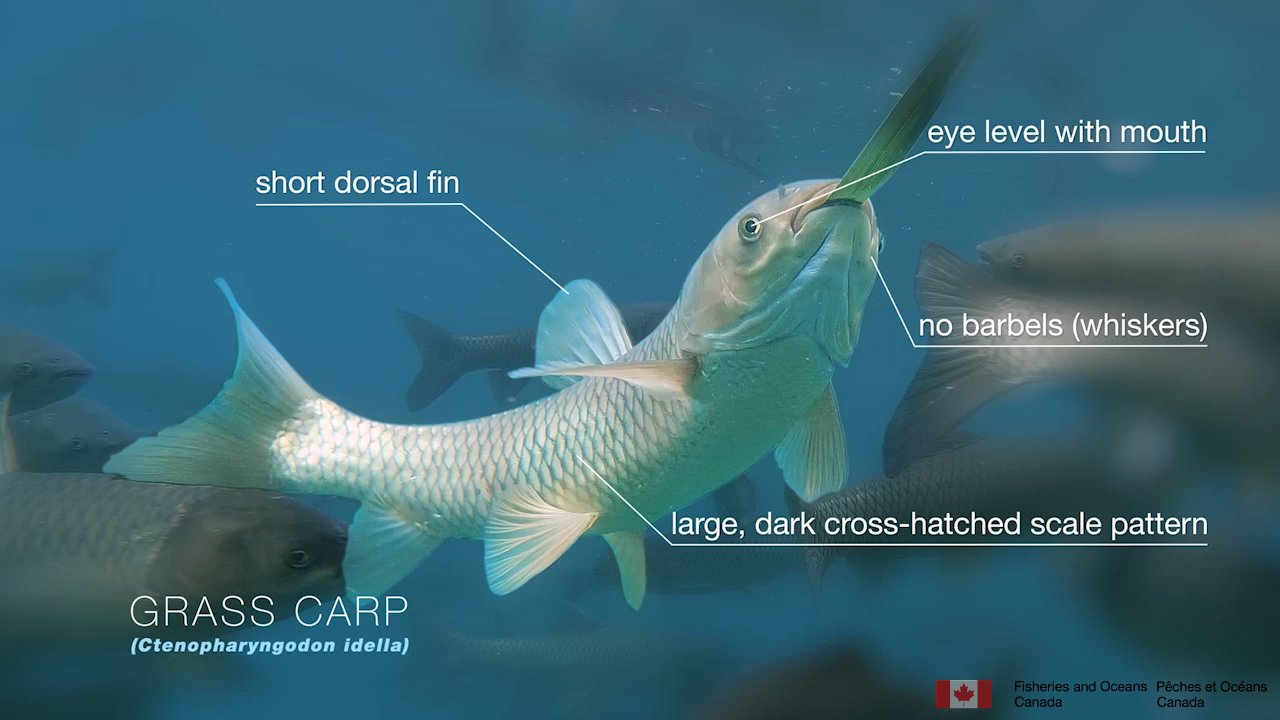
For all of these reasons, it is important to prevent the introduction of Grass Carp into Canadian waters. Luckily, only 29 Grass Carp have been caught in Canadian waters since 2013 – we are in the prevention stage and can take action to keep them out before it’s too late! This can be done by encouraging anglers to check their bait, not to dump unused bait into the water and to report sightings or captures to the Invading Species Hotline (1-800-563-7711). In addition, people should be reminded of federal AIS Regulations, that it is illegal to import, possess, transport or release Grass Carp in Canada, unless it is dead and eviscerated. Learn how to identify Grass Carp to keep an eye out when you are on the water. A common lookalike they are often confused for are Common Carp, however Grass Carp have a short dorsal fin, a large, dark cross-hatched scale pattern, their eyes are level with their mouth, and they don’t have any barbels like Common Carp do.
Identifying Features of Grass Carp (courtesy of Fisheries and Oceans Canada)
To prevent introduction, Fisheries and Oceans Canada’s Asian Carp Program implements an early detection surveillance program alongside partners, including the Ontario Ministry of Natural Resources and Forestry and the Toronto and Region Conservation Authority. From May to November, they target high risk sites to detect and remove these carps, and collect baseline fish community data so that they know what the fish community should look like without these invaders, so if they ever do arrive and establish, the impact can be assessed properly.
If any of the four carp species is caught through early detection surveillance or if there is a confirmed catch reported to the Invading Species Hotline, the Asian Carp Program responds to the capture – this means that they take immediate steps to help reduce or eliminate the threat. The Grass Carp (or carps!) that has been caught will be sent to Fisheries and Oceans Canada’s Asian Carp lab for further analysis so that they can learn more about the fish and its life history. For example: otoliths (ear bones) can tell them about the origin and residence history of the fish; vertebrae, scales and gonads are used to assess age and stage of development; and stomach contents are analyzed to get a better idea of what the fish has been eating. As soon as the fish is in their possession, they check the fertility of the Grass Carp. This is important to know since fertile fish pose a much greater threat because they can reproduce and lead to established populations that can spread, whereas sterile fish will cause damage over their lifetime but not beyond. Grass Carp have been, and still are, stocked in some states in the U.S., and some states require the fish to be sterilized before release so that is why Grass Carp can be either sterile or fertile. Once they know whether the fish can reproduce or not, they better understand the level of threat, and can respond accordingly.
The Asian Carp Program’s response plan is based on the Incident Command System. It has trigger levels that are based on fertility results, species, the number captured, and their life stages. A coordinated response may involve conducting additional surveillance efforts and could include electrofishing, netting, and/or eDNA sampling to ensure that any other individuals that may be out there are caught so that the threat can be eliminated.
If you are out on the water and think that you may have caught a Grass Carp – do not release the fish, take a picture, note your coordinates and call the Invading Species Hotline at 1-800-563-7711. Once it has been confirmed to be a Grass Carp, gut the fish without damaging the head or eyes and keep it in a cooler with its head above the ice. Fisheries and Oceans Canada will come collect it from you!
Here are some helpful resources to learn more about Grass Carp and how to identify them:
- Ontario’s Invading Species Awareness Program – Invasive Fish Guides & Fact Sheets
- Asian Carp Canada
- Asian Carp Canada – Species Confused with Carp